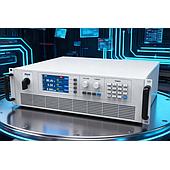
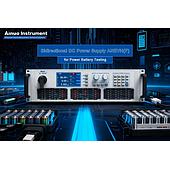
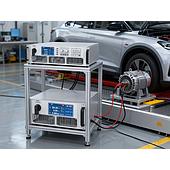
A programmable 3-phase AC power supply is used to generate controlled three-phase alternating current for testing, simulation, validation, and quality assurance. Its configurable electrical output helps engineers reproduce operating conditions that may be difficult to control with a conventional fixed power source.
Common applications include industrial drives, EV power electronics, renewable-energy equipment, aerospace power systems, factory test stations, and academic research. The central value is repeatable testing under defined normal or disturbed power conditions.
Summary: Programmable sources can adjust voltage, frequency, phase angle, waveform, harmonics, and selected transient events. They support repeatable testing of equipment exposed to variable power conditions. They are also suited to software-driven and automated test workflows.
What is a programmable 3-phase AC power supply?
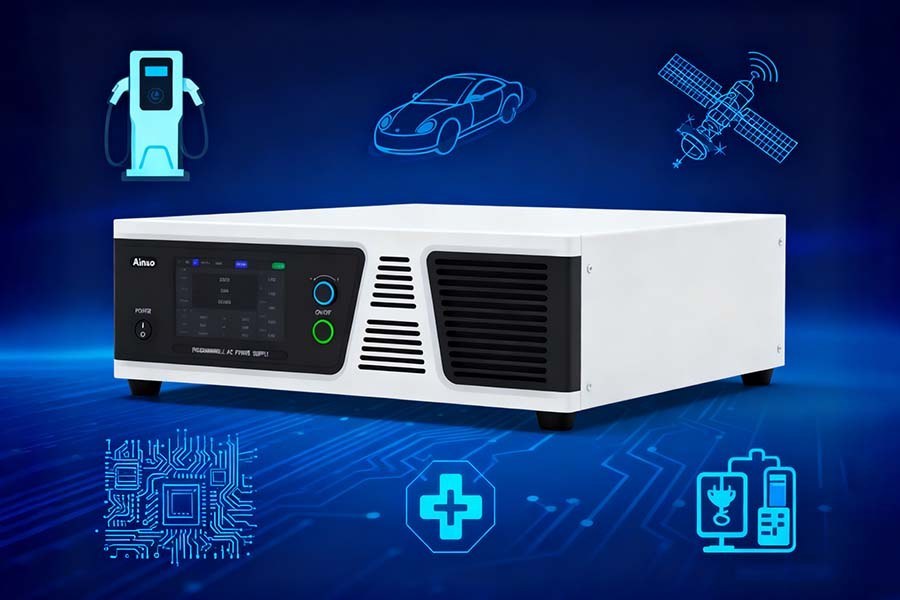
A programmable 3-phase AC power supply is an electrical device that produces three-phase AC with parameters that can be configured for a test. Depending on the test requirement, the controllable parameters may include voltage amplitude, frequency, phase angle, waveform shape, harmonic content, and events such as sags, swells, or interruptions.
Digital or remote control enables a defined condition to be repeated in a laboratory, development setting, or production environment. This is useful where the consistency of the supply condition affects how results are evaluated.
Why use a programmable source instead of a fixed AC supply?
A programmable source is appropriate when a test needs more than a stable nominal three-phase output. It can help recreate voltage and frequency variation, phase imbalance, harmonic distortion, and transient conditions in a controlled manner.
| Testing need | Relevant programmable capability |
|---|---|
| Repeat a defined test condition | Configurable output and digital control |
| Assess response to changing grid conditions | Voltage, frequency, phase, and waveform adjustment |
| Evaluate behavior during disturbances | Simulation of sags, swells, interruptions, and harmonics |
| Run automated test sequences | Remote or software-based control |
How are programmable 3-phase AC power supplies used for industrial drive testing?
They are used to validate industrial motor drives, including variable frequency drives, servo drives, and inverter systems, under changing input conditions. Test teams can examine responses to voltage fluctuation, frequency deviation, harmonic content, startup-related current events, and longer-duration operating conditions.
Repeatable conditions can help identify how a drive behaves during electrical stress or load-related variation before deployment in automation, robotics, conveyors, or heavy machinery.
How do these sources support EV and renewable-energy development?
For EV development, a programmable three-phase source can be used to test motor controllers, inverters, and related power-electronics behavior across different voltage, frequency, and phase conditions. It can also support simulation associated with grid interaction and regenerative-braking conditions.
In renewable-energy and microgrid work, the same approach can reproduce phase imbalance, voltage sags, and harmonic distortion associated with distributed energy conditions. These tests are relevant to grid-tie inverter evaluation, energy-storage stress testing, and control-algorithm development.
Which grid disturbances can a programmable 3-phase source simulate?
Programmable sources can simulate several common power-quality disturbances, including voltage sags and swells, frequency drift, transients, phase imbalance, and harmonics. Controlled fault simulation allows equipment response to be assessed without applying those conditions directly to an operating grid.
Typical evaluation targets include equipment immunity, protective relays, circuit breakers, and system behavior under adverse scenarios. This can be relevant where disruption from poor power quality is a concern, such as automated factories, data centers, and hospitals.
When is automated testing with a programmable AC source useful?
Automated testing is useful when many units, multiple settings, or long-duration tests must be run consistently. In manufacturing, programmable sources can be integrated into test benches for routine testing of products such as motors, drives, and transformers, as well as burn-in and stress tests.
Software-driven test scripts, remote control, automated logging, reporting, and batch operation can reduce manual intervention while improving the traceability of each test sequence.
Can programmable 3-phase AC supplies support compliance and research testing?
Yes. They can generate defined electrical conditions for calibration, standards-related evaluation, and research experiments where reproducibility is important. The source material identifies applications in power electronics, power-system stability, smart-grid and microgrid algorithms, and advanced motor control.
Compliance laboratories may use AC power supply to create standardized test conditions for assessing products against applicable electrical or industry requirements. The required test method and standard depend on the equipment and application being evaluated.
Note: A programmable source provides the test stimulus; whether a product meets a particular standard must be determined using the applicable test procedure and acceptance criteria.