What is an inverter?
Imagine you are driving a car. When you press the accelerator pedal, the car will gradually accelerate. At this time, the electric motor inside the car will rotate faster. The inverter is the part that controls the rotation speed of this motor. It's like an invisible driver, smoothly adjusting the engine's speed, helping you move at your desired speed.
The inverter works by changing the frequency of the current supplied to the motor. When increasing frequency, the motor will rotate faster, and vice versa.
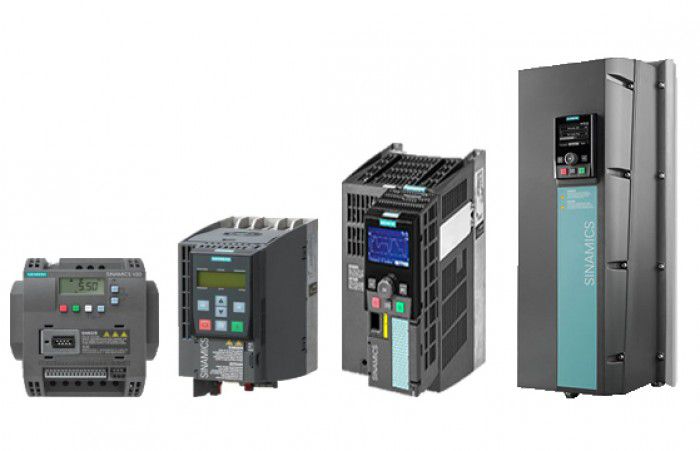
Simply put, an inverter is a smart electronic device capable of changing the frequency of alternating current. Thanks to that, we can adjust the speed of the motor more accurately and flexibly, thereby optimizing the production process and saving energy.
Going back to the ceiling fan example, when you turn the fan on at a light wind level, the inverter will supply the motor with a low-frequency current, causing the fan blades to rotate slowly. On the contrary, when you turn on the fan at a strong wind level, the inverter will increase the frequency of the electric current, causing the fan blades to rotate faster.
Detailed structure of the inverter
- Power supply unit: This unit will take electricity from the national grid and put it inside the inverter. To ensure that the power source is always clean and stable, people often install additional filtering and protection devices, like water filters to remove impurities.
- Voltage regulator (rectifier): Has the function of converting alternating current (AC) into direct current (DC). This direct current will be more stable and easier to control.
- After being rectified, the DC current will pass through the DC filter. This filter will make the current become truly stable, like a steady stream of water.
- Next, the current will go to the DC/AC converter: This part will convert the direct current back into alternating current, but this time the frequency of the current can be changed. You can imagine it as a machine that creates water waves with different frequencies.
- The controller is the "brain" of the inverter: It will receive commands from the user or from other devices, then make decisions to adjust the frequency and voltage of the electric current, thereby Controls the speed and torque of the motor.
- Finally, to ensure stable and durable operation of the inverter, people often equip additional protective devices such as: coolers for heat dissipation, overvoltage, overcurrent, overheating protectors, etc. ..
Related products:
LS inverter
Inverter
Operating principle of the inverter:
The operating principle of the inverter is based on adjusting the frequency of alternating current. Instead of using a fixed frequency power source like the residential power grid, the inverter creates a variable frequency power source.
The inverter's operation process takes place in 4 steps:
1. Convert alternating current (AC) to direct current (DC): First, electricity from the grid (AC form) is fed into the inverter and converted into direct current (DC) through the inverters. rectifier. This DC current will be the energy source for the next processes.
2. Filter and stabilize the current: After being rectified, the DC current still contains some noise. To ensure the quality of the power supply for the following stages, the inverter uses filters to remove noise, creating a stable DC current.
3. Generate alternating current with adjustable frequency: After filtering, the stable DC current will be converted back into alternating current, but this time the frequency of the current can be changed. This process is performed by semiconductor devices such as IGBT or MOSFET, allowing us to adjust the rotation speed of the motor.
4. Motor control: Finally, the inverter's controller will compare the desired input signal with the actual signal of the motor, then adjust the frequency and amplitude of the alternating current to achieve desired speed and torque.
Application of inverter
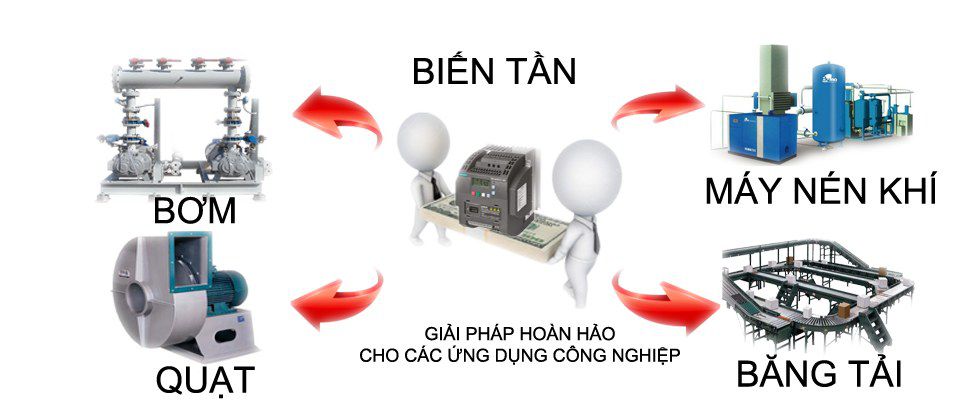
Pumps and water supply systems:
Energy savings: By adjusting pumping speed according to usage needs, the inverter helps reduce power consumption significantly, especially in pumping systems whose load changes over time such as water supply systems for buildings. high-rise building.
Pump protection: Soft start thanks to the inverter helps reduce mechanical shock to the pump, extending the life of the device
Stable pressure adjustment: Inverter helps maintain stable water pressure in the system, avoiding pressure that is too high or too low, affecting the equipment and users.
For example: In irrigation systems, inverters help adjust water flow for each type of crop, ensuring water use efficiency.
Exhaust fans and ventilation systems:
Temperature and humidity control: Inverters help regulate air flow to maintain temperature and humidity at desired levels in buildings and factories.
Noise reduction: Smooth starting and stopping thanks to the inverter helps minimize noise, creating a comfortable working environment.
For example: In commercial centers, inverters are used to adjust ventilation fan speed according to the number of people, helping to save energy and ensure air quality.
Compressor:
Increase compressor life: By reducing start and stop frequency, the inverter helps reduce friction and wear on compressor internal parts, extending the life of the equipment.
Improved performance: The inverter helps the compressor operate at optimal load, reducing energy loss and increasing compression efficiency.
For example: In air conditioning systems, inverters help adjust the compressor's cooling capacity according to the heat load, ensuring comfort and saving energy.
Conveyor:
Smooth starting and stopping helps minimize product damage, especially fragile products.
Prevent incidents such as conveyor belt slippage, minimizing the risk of occupational accidents.
For example: In food factories, inverters are used to adjust conveyor speed, ensuring products are transported safely and continuously.
Application in centrifuge:
- Allows the rotation speed of the gyro to be adjusted accurately, meeting the requirements of each different production process. This ensures the quality of the final product, avoiding overdosing or underdosing of ingredients.
- By adjusting rotation speed, the inverter helps optimize mixing time, minimize equipment wear and save energy.
- Rotation speed directly affects the uniformity of the mixture. The inverter helps maintain a stable speed, ensuring products of consistent quality.
- Diverse applications: Inverters are not only used in powder and concrete mixers but are also widely used in other centrifuges such as liquid separation centrifuges, solid particle separation centrifuges, centrifugal filter...
Conclude:
Above are my shares about what an inverter is, its structure, operating principles, and its applications. If you have any questions, please contact us to receive the earliest response!