A Spectrum Analyzer is commonly used to determine the frequency at which a signal appears and its power level. This approach works well for stable signals but provides limited information when a signal changes continuously over time.
A signal may appear for only a few milliseconds, transmit in time slots, or occur only when equipment switches to a high-load condition. In such cases, the frequency spectrum may show only a signal peak without indicating when the signal appears or how long it lasts.
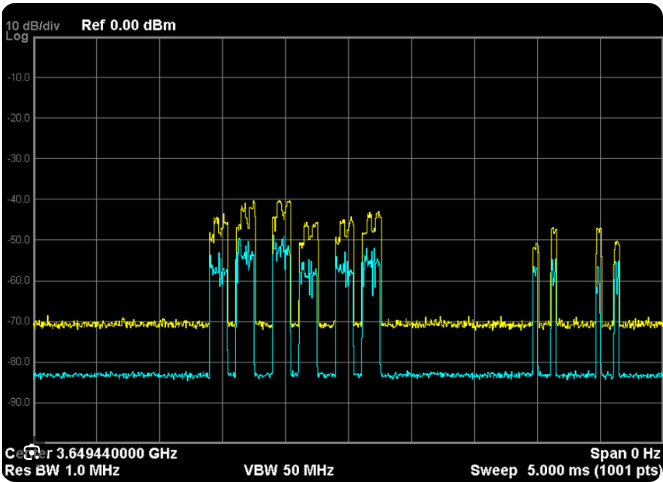
Zero Span addresses this limitation by fixing the analyzer at a specific frequency and monitoring how the signal power changes over time. The horizontal axis is no longer frequency but time.
Zero Span Changes How a Spectrum Analyzer Observes Signals
In the standard sweep mode, the analyzer scans across a frequency range and displays the signal level at each frequency. When switched to Zero Span, the frequency span is set to 0 Hz. The analyzer remains fixed at the center frequency and records changes in signal power over time.
This can be illustrated simply as:
Frequency sweep: Power – Frequency
Zero Span: Power – Time
As a result, engineers can determine not only where a signal is located but also when it appears, how long it lasts, how often it repeats, and how its amplitude changes.
A pulsed signal is a typical example. During a frequency sweep, the analyzer can identify the signal frequency but may not clearly show how long each pulse lasts. Switching to Zero Span at that frequency converts the pulse sequence into a time-domain waveform, making it possible to observe the start and end of each pulse and the interval between pulses.
This measurement method is also useful for interference sources that appear only when a motor starts, a power supply switches to a high-load condition, or a functional block is activated.
When Should Zero Span Be Used? How Do RBW and Sweep Time Affect the Measurement?
Zero Span is suitable when the goal is to examine the behavior of a signal at a specific frequency rather than search for signals across an entire frequency range.
One important parameter to consider is the resolution bandwidth (RBW). Although the analyzer no longer sweeps across frequency, the signal still passes through a filter with a bandwidth corresponding to the RBW. If the RBW is too narrow compared with the signal bandwidth, part of the signal energy may be excluded from the measurement. For pulsed signals, this can also alter the observed waveform shape.
Conversely, a wider RBW allows more signal energy to be captured but reduces the ability to distinguish closely spaced frequency components. Therefore, the RBW should be selected according to the bandwidth of the signal being monitored rather than using a fixed setting for every measurement.
The sweep time determines the time interval displayed along the horizontal axis. If a signal lasts only a few milliseconds but the observation window is too long, the pulse will occupy only a very small portion of the screen. Narrowing the observation time makes the waveform clearer and makes it easier to identify characteristics such as pulse width and the interval between transmissions.
For repetitive signals, triggering the measurement at a defined threshold can also help stabilize the waveform on the screen. This is useful for observing events that occur rapidly but repeat at regular intervals.
In other words, in Zero Span mode, RBW determines the frequency range through which the analyzer captures the signal, while sweep time determines the time interval over which the signal is observed. These two parameters directly affect the shape of the measurement result.
How Is Zero Span Different from an Oscilloscope?
The display of Zero Span is quite similar to that of an oscilloscope because both display amplitude over time. However, the underlying measurement principles are different.
An oscilloscope observes voltage or current as a function of time.
For example, when testing a pulsed RF transmitter, a Spectrum Analyzer in swept mode can be used to determine the frequency at which the signal is located and identify its spectral components. Zero Span can then be used to observe the pulse width, repetition period, or changes in the signal power over time.
Combining these two measurement approaches makes it possible to analyze both the frequency content and the time-domain behavior of the signal.
Zero Span Helps Detect Problems That May Be Overlooked in the Frequency Spectrum
A stable spectrum peak does not necessarily mean that the transmitter is operating continuously. The peak may be generated by repetitive pulses occurring at a sufficiently high repetition rate to appear as a stable component in the spectrum.
Similarly, an interference source that operates only when the load increases can be difficult to trace if the spectrum is observed only while the equipment is operating under normal conditions. By fixing the analyzer at the suspected frequency using Zero Span, engineers can correlate the timing of the interference with load switching, motor startup, or changes in the circuit's operating state.
This is one of the key advantages of Zero Span in troubleshooting: it not only detects that a signal exists but also helps identify the conditions under which the signal appears.
For radio systems, pulsed transmitters, radar equipment, switching power supplies, and RF circuits, this information can help narrow down potential causes more quickly than observing the frequency spectrum alone.
This mode is particularly useful for pulsed signals, intermittent signals, and interference sources that depend on operating conditions. By properly combining the center frequency, RBW, and sweep time, engineers can clearly observe the occurrence time, pulse width, and repetition period of a signal on a Signal and Spectrum Analyzer.