Phase loss protection is a protective measure that monitors three-phase AC power supplies to prevent equipment, particularly motors, from operating when one phase loses voltage or experiences a severe voltage drop. This fault disrupts the balance of the three-phase system and can cause overheating, reduced torque, or motor shutdown.
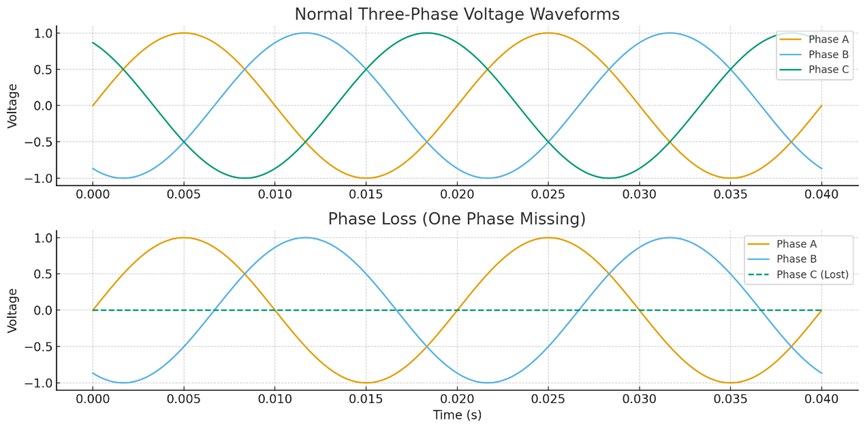
Under normal three-phase conditions, the three voltages have equal magnitudes and are separated by 120° in phase. When one phase is interrupted, the remaining phases may carry excessive current. Appropriate fault detection and control circuit disconnection are therefore essential.
Summary: Phase loss occurs when one phase is completely interrupted or experiences a severe voltage drop. Motors may fail to start, produce reduced torque, or overheat. Phase loss relays monitor three-phase power supplies to protect control circuits. Checking terminals, cables, and voltage balance helps reduce the risk of failure.
What Is Phase Loss in a Three-Phase Electrical System?
Phase loss occurs when one phase loses its voltage completely or experiences a severe voltage drop, causing the system to operate under unbalanced conditions. This is a type of unbalanced fault. Although the fault current may be lower than that of a short circuit, it can still cause significant damage to three-phase loads.
When the system's symmetry is disrupted, the current and electromagnetic fields become unbalanced. Neutral current may increase, torque fluctuations may become more pronounced, and the risk of equipment damage also rises.
What Are the Common Causes of Phase Loss?
Phase loss can originate from the power supply line, protective components, connection points, cables, or the upstream power grid. Inspections should focus on locations where an individual phase may become disconnected.
- Broken supply conductor: Caused by mechanical damage, insulation failure, or improper operation.
- Blown fuse: One fuse blows while the other phases remain energized.
- Loose or oxidized connections: Particularly important in environments subject to vibration. A connection point may overheat and interrupt the phase.
- Aged or moisture-damaged cable insulation: Can lead to insulation failure in one phase.
- Upstream power grid faults: Single-phase interruptions or voltage imbalances in the supply network may affect downstream equipment.
How Does Phase Loss Affect Three-Phase Motors?
Three-phase motors are particularly sensitive to phase loss because their rotating magnetic field depends on balanced three-phase currents. If a phase is lost during startup, the motor may be unable to develop sufficient starting torque. Attempting to start the motor under these conditions can cause locked-rotor current to rise several times above the rated current.
If phase loss occurs while the motor is running, the motor may continue to rotate, but the current in the two remaining phases can increase significantly. In typical cases, this increase may reach 2–3 times the rated current, causing rapid winding temperature rise, insulation damage, and potentially motor burnout if the condition persists.
| Operating Condition | Main Effects on the Motor |
|---|---|
| Phase loss during startup | Insufficient starting torque, potentially resulting in locked-rotor current and winding overheating. |
| Phase loss during operation | Increased current in the remaining phases, rising winding temperature, and possible insulation damage. |
| Heavy load | Reduced output power and torque, with a risk of motor stalling. |
Why Are Fuses and Thermal Overload Relays Not Sufficient for Phase Loss Protection?
Fuses and thermal overload relays still play important protective roles, but they may not respond quickly enough to phase loss. Thermal overload relays operate in response to overload conditions, making them more suitable as an additional layer of protection alongside dedicated phase loss detection devices.
Note: Phase loss does not necessarily produce a current as high as that associated with a short circuit. As a result, a fault that is difficult to detect may still cause a motor to operate under unfavorable thermal and torque conditions.
How Does a Phase Loss Relay Work?
A phase loss relay, also known as a phase sequence relay, continuously monitors the three-phase power supply. If a phase disappears or a severe voltage imbalance occurs, the device can disconnect the control circuit to prevent the motor from continuing to operate under hazardous conditions.
Periodic testing and maintenance help verify that the relay operates correctly. Protection relay test set can simulate phase loss faults for testing and maintenance purposes.
Which Measures Should Be Combined to Prevent Phase Loss?
Effective prevention requires a combination of power supply monitoring, motor protection, and connection inspections. For critical equipment, phase loss relays or intelligent motor protection relays can be used according to the required protection functions.
- Check terminal tightness and look for signs of oxidation or overheating.
- Inspect cables for moisture and insulation aging.
- Monitor supply voltage balance and use power quality analyzers when necessary.
- Coordinate the settings of overload protection, thermal relays, and phase loss protection rather than relying on a single protective device.
When Is Phase Loss Monitoring Required at the System Level?
Phase loss monitoring can be implemented at different levels, depending on the system configuration. Current transformers and relays at substations can detect current imbalance; at the low-voltage level, phase loss relays provide rapid protection; in automation systems, PLCs equipped with current sampling modules can monitor operating conditions and issue alarms.
This approach links protection functions from the power supply to the connected load, rather than waiting until the motor shows signs of overheating or reduced torque before taking action.