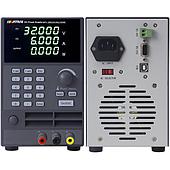
In home appliance manufacturing, electrical safety tester is used to test products before they are packaged and shipped. These tests are performed to detect insulation faults, verify the protective grounding path, and evaluate the product's ability to withstand electrical stress under specified conditions.
Depending on the product design and technical requirements, a production line may combine several tests, including withstand voltage, insulation resistance, and ground bond testing. For high-volume production, these tests need to be standardized to maintain consistent test times, measurement conditions, and evaluation criteria across products.
Electrical Safety Tests
The withstand voltage test is used to evaluate the electrical strength of the insulation system. A test voltage is applied between energized parts and parts that must remain electrically isolated for a specified period. If insulation breakdown occurs or the current exceeds the preset limit, the product is classified as a failure.
Insulation Resistance (IR) testing focuses on the ability of the insulation to prevent current from flowing between conductive parts. An abnormally low insulation resistance may be associated with insulation materials, moisture, insufficient insulation distance, or assembly defects.
Ground Bond testing verifies the protective path between the grounding terminal and accessible metal parts that may come into contact with the user. The resistance of this connection must remain within the specified limit to ensure that fault current can flow through the protective grounding path.
These three tests evaluate different characteristics of a product while sharing the same objective: reducing the risk of electric shock and failures caused by insulation defects.
Selecting Electrical Safety Test Equipment for a Production Line
Selecting electrical safety test equipment involves more than determining the number of required tests. The test voltage, test current, dwell time, evaluation limits, and product construction should all be defined in advance to establish an appropriate test program.
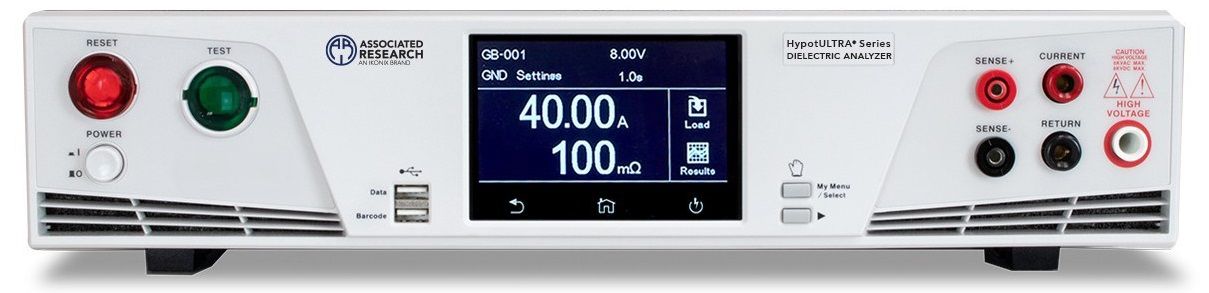
For production lines that require multiple electrical safety tests on the same product, the HypotULTRA 7804
electrical safety tester can combine several testing functions within a single system. This configuration reduces the need to move products between different test stations and simplifies the standardization of test programs for each product model.
For test stations where individual tests are performed separately, the Hypot 3805
can be used for withstand voltage testing, while the HYAMP 3240 performs Ground Bond testing. A configuration using separate instruments is suitable for production lines with simpler test procedures or relatively lower production volumes.
Managing Test Data on the Production Line
During manual testing, operators must make the correct connections and select the appropriate test program for each electrical safety tester. On production lines handling multiple product models, controlling these operations becomes increasingly important to prevent the wrong test program from being applied.
Test systems can be integrated with product identification and the corresponding test program. Once the product is identified, the system loads the predefined parameters and records the result of each test. This data can be used for traceability when a product needs to be rechecked or when the cause of a failed test needs to be investigated.
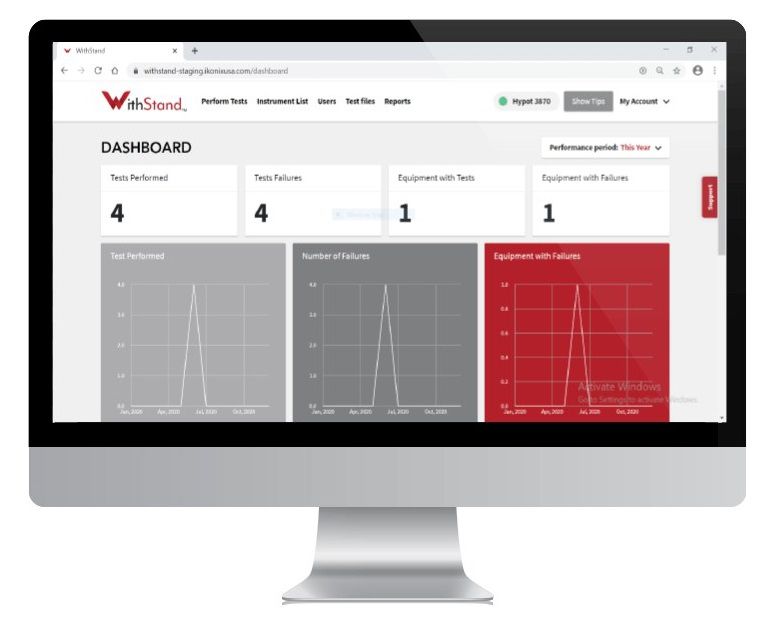
For the HypotULTRA 7804 electrical safety tester, WithStand software supports the setup and management of test programs. Standardizing test parameters helps reduce dependence on direct configuration by operators.
Electrical Safety Testing as Part of Quality Control
Electrical safety testing is not limited to classifying products as pass or fail. Test results can also provide information about the quality of the assembly process.
For example, an increase in Ground Bond resistance may be associated with a conductor, connector, or contact point. Abnormal results from a withstand voltage or insulation resistance test may indicate the need to inspect the insulation material, clearance between conductive parts, or assembly process.
The test procedure should therefore be standardized from parameter configuration and product connection to result recording. For high-volume production lines, automation and test data storage help maintain consistency across products while providing traceability when defects occur.
A suitable testing solution needs to balance electrical safety requirements, production speed, and data management. From individual test stations to systems integrating multiple tests, the final configuration should be selected according to the characteristics of the electrical safety test equipment and the actual production process of each manufacturing line.
EMIN is the exclusive distributor of Associated Research in Vietnam. Contact us for consultation on the appropriate solution, equipment setup, and operator training for your test system.