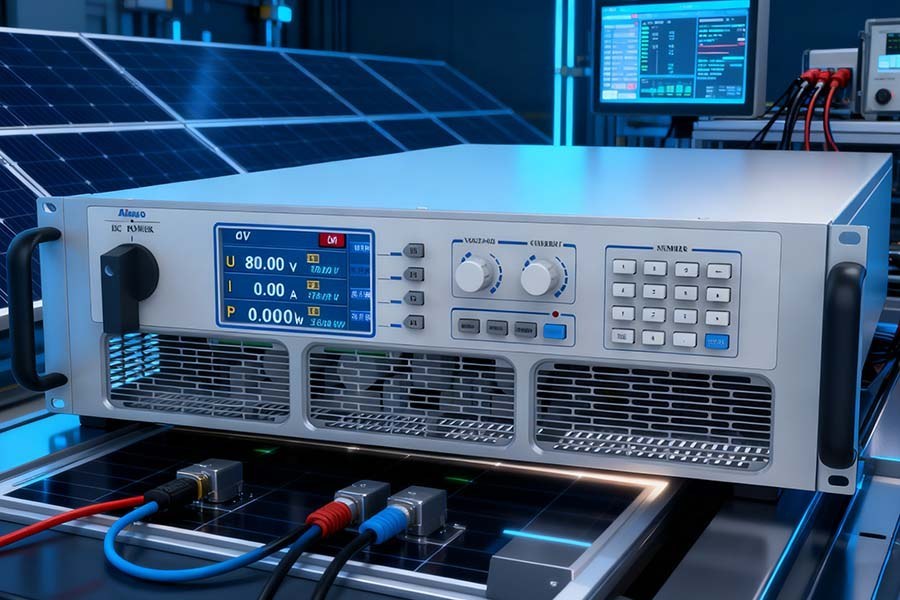
Bidirectional DC power supplies for PV testing can both deliver and absorb electrical energy, switching between source and load operation. This makes them useful for laboratory evaluation of PV inverters, battery-related systems, and integrated PV-storage configurations where power flow changes over time.
Rather than relying only on field conditions or separate source and load instruments, a bidirectional unit can provide a more controlled way to reproduce selected voltage, current, and energy-flow scenarios. Its suitability still depends on the required test conditions and the capabilities of the specific equipment.
Summary: Bidirectional units combine source and load functions. They can support PV output and battery behavior simulation. Energy feedback can be useful in long-duration, high-power testing. Controlled test conditions can improve repeatability.
What is a bidirectional DC power supply?
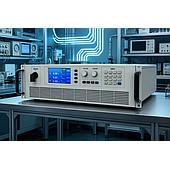
A bidirectional DC power supply is a device that can supply electrical energy and absorb it. It can transition between source and load modes, unlike a conventional DC supply that only provides output in one direction.
In PV and energy-storage testing, this operating principle aligns with systems that experience charging, discharging, generation, and changing load conditions. It can therefore be used in development and verification work involving inverters, power conversion systems, batteries, and combined PV-storage systems.
Why are bidirectional DC power supplies suitable for PV testing?
PV and storage systems operate under changing energy conditions, so tests often need to reproduce changing voltage, current, and power flow. A bidirectional supply can simulate these conditions in a controlled setting while serving as either a source or an absorbing load.
Traditional arrangements may use a separate DC power supply and electronic load. Integrating both roles in one bidirectional device can reduce the number of instruments needed and support faster transitions between operating modes.
How can a bidirectional DC power supply be used to test PV inverters?
For PV inverter testing, a bidirectional supply can be programmed to simulate PV outputs with different irradiance-related conditions and dynamic changes. This supports assessment of inverter MPPT tracking, dynamic response, and startup behavior.
It can also help reproduce situations associated with changing illumination, module temperature changes, or multi-peak IV curves caused by shading. Compared with using actual PV modules, laboratory simulation is less dependent on weather and location and can be repeated under the same selected conditions.
Can bidirectional DC power supplies simulate batteries and energy-storage systems?
Yes. A bidirectional DC power supply can simulate battery charging and discharging behavior for energy-storage PCS and battery-system development. Potential applications include voltage-curve simulation, charge-discharge cycle testing, and safety-strategy verification without using an actual battery.
For BMS-related work, the source material identifies verification of balancing strategies, voltage sampling accuracy, and protection thresholds as relevant uses. Simulated testing avoids handling certain battery hazards, such as short circuits and thermal runaway, that may arise during high-rate operation of physical batteries.
How do bidirectional supplies support PV module and IV curve simulation?
Combined with software algorithms, a bidirectional DC power supply can simulate PV module IV curves under different irradiance and temperature conditions. This can be relevant to inverter manufacturers and teams developing MPPT controllers.
PV simulation enables a test team to set defined conditions rather than wait for natural sunlight. The result is a controlled basis for comparing tests, provided that the programmed model represents the intended operating scenario.
Why is energy feedback relevant for aging and burn-in testing?
During aging or burn-in tests, a bidirectional supply can absorb energy and feed it back to the grid. This differs from a traditional load that dissipates absorbed energy as heat.
For long-duration, high-power testing of inverters, energy-storage equipment, or controller modules, feedback can reduce wasted energy and the heat burden associated with load dissipation. The source describes this as particularly relevant where continuous high-power absorption is required.
What can be evaluated in an integrated PV-storage test setup?
A bidirectional DC power supply can be used to simulate both PV generation and battery behavior alongside an inverter, creating a controlled microgrid-oriented test setup. This can support evaluation of energy-management strategies under different operating conditions.
Examples include examining the system response when simulated sunlight weakens or observing storage switching behavior between grid-connected and off-grid conditions. Repeatable laboratory scenarios can help teams compare control behavior across tests.
What should teams consider when selecting a bidirectional DC power supply for PV testing?
Selection should begin with the intended application: inverter evaluation, battery simulation, IV curve simulation, aging, or system-level testing. The required voltage, power, dynamic response, control precision, and ability to reproduce the needed test profile should match the test objective.
Communication and automation requirements may also matter. The bidirectional DC power supply test systems may use CAN, Modbus, or EtherCAT interfaces for automated testing, centralized data handling, and batch workflows.
Note: PV voltage platforms and module technologies continue to evolve. Test equipment and simulation algorithms should be assessed against the voltage range, IV-curve characteristics, and control requirements of the specific system being evaluated.