The development of artificial intelligence, electric vehicles, and power electronics is placing increasingly demanding requirements on semiconductor devices. Engineers need more than just an understanding of transistor or integrated circuit operating principles. They must also be capable of performing measurements, analyzing electrical characteristics, and validating devices under different operating conditions.
For electrical and electronics engineers looking to enter this field, knowledge of semiconductor physics and circuit theory provides an essential foundation. However, the ability to use specialized test equipment to characterize current-voltage behavior, observe switching signals, evaluate noise, and verify device performance is what directly connects theoretical knowledge with practical laboratory work.
At the Tektronix Semiconductor 2026 seminar, alongside technical presentations on semiconductor technologies, attendees had the opportunity to explore and experience live equipment demonstrations featuring the DPO1000, Keithley 4200A-SCS, MSO58B, and EA-PSB 10000 bidirectional DC power supply. Each instrument serves a different measurement purpose, illustrating key technical requirements in semiconductor research and device validation.
1. DPO1000 – Observing and Analyzing Electrical Signals in Circuits
In electronics research, waveform observation is the first step in determining whether a circuit is operating as intended. The DPO1000 oscilloscope enables engineers to monitor voltage variations over time and evaluate signal amplitude, period, frequency, rise time, and transient behavior.
Through the equipment demonstration, attendees can explore how to use an oscilloscope to observe control signals, pulse signals, and circuit responses. Phenomena such as noise, oscillations, overshoot, and timing deviations during state transitions can be identified directly from the waveforms.
These are fundamental yet essential skills when testing transistor control circuits, power supplies, and electronic functional blocks in semiconductor systems.
2. Keithley 4200A-SCS – Measuring and Analyzing the Electrical Characteristics of Semiconductor Devices
While an oscilloscope helps engineers observe signals over time, the Keithley 4200A-SCS focuses on characterizing the electrical parameters of semiconductor devices and materials.
The system supports current-voltage (I-V), capacitance-voltage (C-V), and pulsed I-V measurements. These are important techniques for researching diodes, MOSFETs, transistors, and semiconductor material structures.
For example, when performing I-V characterization on a MOSFET, engineers can vary the gate and drain voltages to collect current data, enabling them to determine threshold voltage, leakage current, and conduction characteristics. With C-V measurements, changes in capacitance under different bias voltages provide insights into junction structures, dielectric layers, and device characteristics.
In particular, its capability to measure very small currents makes the system suitable for investigating high-impedance samples and evaluating subtle electrical deviations that may be difficult to detect using conventional measurement instruments.
Experiencing the Keithley 4200A-SCS helps attendees better understand how semiconductor physics principles can be translated into experimental measurement data to support research, process development, and device failure analysis.
3. MSO58B – Simultaneous Analysis of Analog and Digital Signals
In modern electronic systems, analog and digital signals often coexist. Observing only one type of signal may not be sufficient to identify the root cause of operational problems.
The Tektronix MSO58B belongs to the 5 Series B Mixed Signal Oscilloscope family. It features an 8-channel analog configuration and supports up to 64 digital channels with optional configurations. The instrument offers bandwidth options ranging from 350 MHz to 2 GHz and a maximum sample rate of 6.25 GS/s.
Its multi-channel capabilities allow engineers to compare voltage signals, current signals, and logic signals within the same operating cycle. This is particularly useful for examining the relationship between control signals and the actual responses of electronic devices.
In semiconductor applications, the instrument can support switching signal analysis, response time verification, noise detection, and synchronization assessment between functional blocks. For control circuits and embedded systems, combining analog and digital data also helps engineers identify potential faults more efficiently.
Through the demonstration, attendees can explore how to use multiple measurement channels to analyze an entire electronic system rather than examining individual signals in isolation.
4. EA-PSB 10000 – Bidirectional DC Power Testing and Operating Condition Simulation
In the research and development of power semiconductor devices, power supply and load simulation are two essential requirements. Engineers need to evaluate device performance as voltage, current, and power vary under different operating conditions.
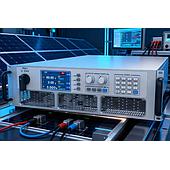
The Elektro-Automatik EA-PSB 10000 is a series of bidirectional DC power supplies that combines power supply and electronic load functions in a single instrument. In source mode, the system provides programmable DC voltage and current. In sink mode, it absorbs energy from the device under test and can feed the recovered energy back into the electrical grid.
This operating principle is particularly useful for testing power converters, inverters, battery systems, and power electronic devices. Instead of using separate DC power supplies and electronic loads, engineers can perform both functions with a single system.
The EA-PSB 10000 series offers configurations with power ratings of up to 30 kW, while voltage ranges vary by model from 60 V to 2,000 V. Its programmable operation and control capabilities allow engineers to simulate different load conditions and evaluate the characteristics and stability of the devices under test.
For engineers working in power semiconductor research, this is a valuable tool for evaluating the performance of power converters based on SiC/GaN devices, particularly in applications with demanding efficiency and power density requirements.

5. Integrating Test and Measurement Instruments to Enhance Semiconductor Research Capabilities
The four instruments represent different functional categories, yet they are closely interconnected throughout the semiconductor research and validation process.
The Keithley 4200A-SCS characterizes the electrical properties of individual semiconductor devices. The DPO1000 and MSO58B support waveform observation, signal analysis, and circuit performance verification. Meanwhile, the EA-PSB 10000 provides an adjustable power supply and load environment for testing devices under different operating conditions.
Combining these measurement techniques gives engineers a more comprehensive understanding of the relationship between device characteristics, signal behavior, and overall system performance. This also provides a foundation for identifying deviations, investigating failure causes, and validating research results.
For engineering students, lecturers, and professionals working in electrical and electronics engineering, hands-on experience with measurement instruments offers valuable insight into the practical requirements of the semiconductor industry.
Explore Semiconductor Testing and Measurement Technologies at Tektronix Semiconductor 2026
To help the engineering community gain access to advanced measurement and validation solutions, EMIN, in collaboration with Tektronix, is organizing the Tektronix Semiconductor 2026 seminar at the National Innovation Center (NIC) in Hanoi.
In addition to in-depth presentations on wide-bandgap semiconductor materials such as SiC/GaN, failure analysis, and system validation for Physical AI applications, the program will feature live equipment demonstrations and direct technical discussions with experts.
This is an opportunity for attendees not only to update their knowledge of semiconductor technologies but also to observe how measurement instruments are applied in real-world semiconductor research, development, and device testing.
Seminar Information:
Time: 09:00 – 14:00, November 11, 2026
Venue: 6th Floor, NIC Building, Alley 7 Ton That Thuyet Street, Cau Giay District, Hanoi, Vietnam
Organizers: EMIN in collaboration with Tektronix
Admission: Free of charge
Registration: https://emin.vn/hoi-thao-tektronix-semiconductor-2026-2286/ne.html