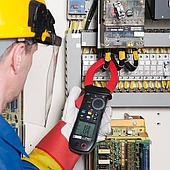
In this article, I will share details about strain gauges, operating principles, practical applications as well as some experiences in choosing to buy and use that I have quickly accumulated. Hopefully this information will be useful for those who are learning or preparing to work with this device.
Easy to understand explanation of What is a Strain Gauge?
As the name suggests, a strain gauge (strain meter or strain gauge indicator) is a device used to measure changes in size, shape or stress of a material when subjected to force, heat or the environment. Simply put, when a bridge is subjected to vehicle load, or a metal bar is subjected to tension and compression, it will have a certain expansion. These changes are often very small, difficult to see with the naked eye, but the strain gauge will read and display specific numbers.

The good thing here is that thanks to the measured data, engineers can know exactly whether the material or structure is still safe or not, whether it is exceeding the tolerance limit or still within the safety zone. Without this device, the inspection is only subjective and the risks in production or construction will be very high.
How the device works
Strain gauges usually work based on strain gauge sensors. This is a very sensitive sensor, usually a resistive wire or thin film that is glued directly to the surface of the material to be measured. When the material deforms, the sensor also changes shape and causes the resistance to change. The strain gauge will receive this signal, amplify it and display it on the screen as easy-to-read data.
It sounds complicated, but just imagine: it's like when we stretch a rubber band, it will become thinner. Strain gauges work on the same principle, except that they are so sensitive that they can detect very small changes, measured in microstrain (μɛ).
Practical applications of strain gauges
Strain gauges are not only found in laboratories but are also present in many fields:
- Construction and infrastructure
Testing the bearing capacity of bridges and high-rise buildings.
Monitoring ground deformation in hydroelectric projects and underground tunnels.
- Manufacturing industry
Measuring forces and loads in the production of mechanical components.
Controlling the quality of materials in the production line.
- Scientific research and R&D
Analysis of mechanical properties of metals, plastics, composites.
Testing new materials in the lab.
- Precision mechanics
Measure clamping force, pressing force, pulling force in specialized equipment.
Serving inspection and calibration of machinery.
It can be said that without this device, many industries would be almost unable to ensure safety or research new materials.
Popular strain gauges
On the market today, there are many types of handheld, desktop or directly attached strain gauges with strain gauge sensors. Some common OMEGA models include OMEGA DP7600-S2-A10, OMEGA CNIS3224-C24, OMEGA DP7700-R,... or fixed models from MITUTOYO. The common features of these models are clear LED display, wide measuring range, high sensitivity and good connectivity with different types of strain gauges. Some types also support multi-channel, meaning that multiple sensors can be connected at the same time, which is very convenient for monitoring multiple deformation points in the same structure.
In addition, new models also have temperature compensation features, limiting errors due to environmental changes. This is a point that you should pay attention to when choosing, especially if the work takes place outdoors or in harsh conditions.
Experience in choosing strain gauge
When buying a strain gauge, don't just look at the price. I have some small experiences for you to refer to:
- Determine the purpose of use: If it only serves small research, a single-channel machine is enough. But if you do a large project with many measuring points, you should choose a multi-channel type.
- Suitable measuring range: Not all machines can measure the same range. See what range the material you need to measure has deformation in to choose the right one.
- Stability and calibration ability: For jobs that require high accuracy, the machine must be stable for a long time and easy to calibrate.
- Working environment: If outdoors, the machine needs to be resistant to dust and moisture. If in the lab, it can be more flexible.
- Connectivity: Some modern models allow connection to a computer to export data and draw charts, which is very useful for research.
Trend of strain gauges
The current trend is that strain gauges are becoming more compact, smarter and easier to connect. Many companies have developed devices that can transmit data wirelessly, synchronizing directly with analysis software on computers or phones. This helps engineers monitor strain in real time even when they are away from the construction site.
In addition, the integration of artificial intelligence in data analysis is also being researched, helping to predict risks early instead of just measuring and displaying as before.
Conclude:
For beginners, strain gauges may not be a familiar name to many people, but in the engineering and research world, this is an indispensable device. From monitoring construction safety to researching new materials, it plays a fundamental role.
Hopefully through the above sharing, you will better understand what a strain gauge is, what it is used for and how to choose the right one. If anyone has used any effective model, please share more for everyone to refer to, because practical experience is always the most valuable thing.