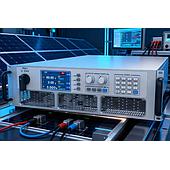
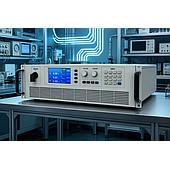
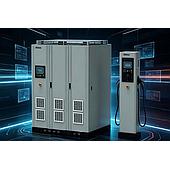
ANEVH is bidirectional DC power supply by combining bidirectional source and load functions in one programmable DC power supply. This arrangement is intended to support battery and grid simulation while simplifying the test circuit used for bidirectional on-board charger evaluation.
For BOBC development and production work, the relevant benefit is a test setup that can handle energy flow in both directions and perform fast forward/reverse switching. The available capabilities and operating ranges should still be matched to the specific test plan and device under test.
Summary: ANEVH integrates source and load functions in one unit. It supports bidirectional energy flow and 1.5 ms forward/reverse switching. A single unit is specified for 0–2250 V, 0–510 A, and up to 30 kW; parallel operation is stated to reach up to 1 MW.
What is a bidirectional on-board charger, or BOBC?
A bidirectional on-board charger is an EV charging component that, in addition to charging the vehicle battery, can support power transfer in other directions. The source describes applications including V2G, V2V, V2L, and V2H/B power interaction.
In this context, V2G refers to vehicle-to-grid feedback. The other listed modes describe power use or transfer involving another vehicle, a load, or a home/building-related application. Because a BOBC must operate across more than one power-flow direction, its testing process can be more complex than that of a traditional OBC.
Which electrical performance tests are relevant to OBC testing?
The stated OBC electrical performance tests include input voltage range, input frequency range, startup input impulse current, harmonic current, power factor, and power-supply environment simulation. The source identifies GB/T 40432-2021 as a reference standard for these test areas.
These test items examine how an on-board charger responds to changing input and supply conditions. For a BOBC, a test approach also needs to account for its bidirectional operating role rather than evaluating charging behavior alone.
How does ANEVH simplify a BOBC test setup?
ANEVH is described as a bidirectional programmable DC power supply that can simulate both a power battery and the grid. Its main setup-related feature is the integration of source and load functions into a single device.
Using one unit for these two roles may reduce the need for separate source and load equipment in applicable BOBC test circuits. This can make the circuit arrangement more straightforward for R&D and production testing, provided the selected configuration meets the required voltage, current, and power conditions.
Why do bidirectional energy flow and switching speed matter in BOBC tests?
Bidirectional energy flow is relevant because a BOBC can charge a battery and support reverse-direction power applications. ANEVH is specified with bidirectional energy flow and a 1.5 ms forward and reverse switching speed.
The unit is also described as having automatic energy feedback and active power factor correction. According to the supplied product information, its full-load power factor exceeds 0.99, which is a stated electrical characteristic rather than a substitute for validating the complete test system.
What operating ranges does ANEVH provide for BOBC testing?
A single ANEVH unit is specified for a voltage range of 0–2250 V, a current range of 0–510 A, and maximum output power of 30 kW. The product is described as a compact 3U unit.
| Specification | Stated ANEVH capability |
|---|---|
| Form factor | 3U |
| Voltage range per unit | 0–2250 V |
| Current range per unit | 0–510 A |
| Maximum output power per unit | 30 kW |
| Forward/reverse switching speed | 1.5 ms |
| Maximum power with parallel connection | Up to 1 MW |
For higher-power requirements, multiple ANEVH devices are stated to support parallel connection, with total power up to 1 MW. This makes parallel operation a consideration where a single 30 kW unit is not sufficient for the intended test condition.
Which automotive grid waveforms can ANEVH generate?
ANEVH is described as having built-in automotive power-grid voltage curves for DIN40839, ISO-16750-2, and ISO21848. It is also stated to generate a variety of waveforms for different test occasions.
This capability is relevant when BOBC tests need to reproduce defined vehicle power-supply voltage conditions. The exact waveform, sequence, and acceptance criteria should be selected according to the applicable test requirement.
Note: Voltage, current, power, switching, and waveform requirements should be confirmed against the BOBC under test and the applicable test standard before configuring equipment.
When Should You Prioritize a Bidirectional DC Power Supply for BOBC Testing?
A bidirectional DC power source is worth considering when you need to simulate both the battery side and the grid side, or evaluate energy exchange in both directions. For the ANEVH series, the key benefit highlighted in the product specifications is the integration of a power source and an electronic load, helping simplify BOBC-related test circuits.
To select the right solution, start by determining the voltage, current, and power ranges required for the test. Then, assess waveform generation requirements, automotive grid voltage curve simulation, and parallel operation capabilities. This approach helps narrow down the options based on verifiable technical specifications.