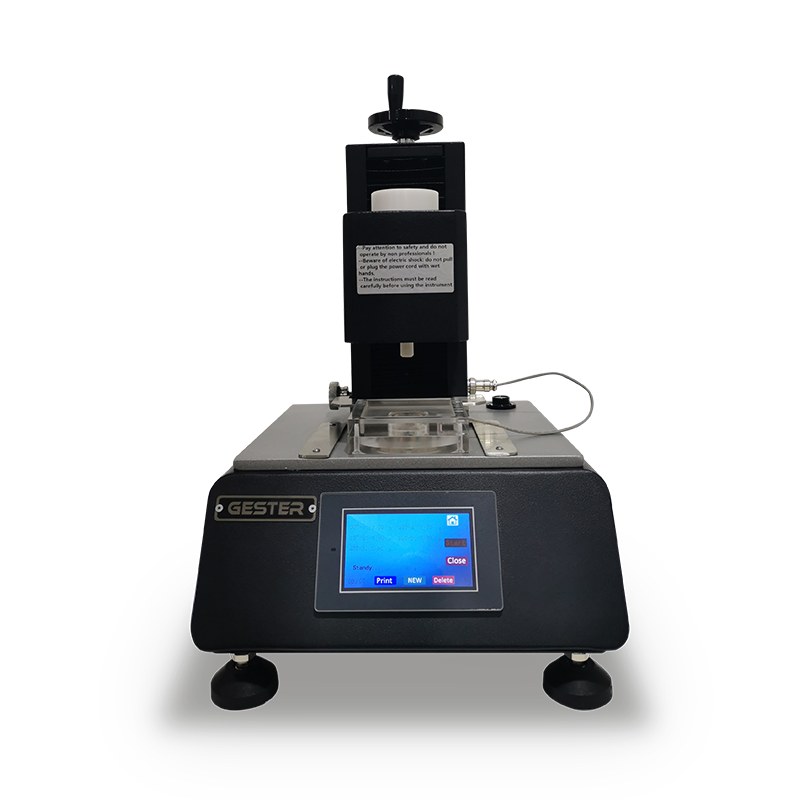
Softness is an important evaluation point when assessing high-grade toilet paper, fiber paper products, and tobacco flakes. A consistent test approach helps quality control teams compare samples, monitor production variation, and document results for internal review. The GT-CN05 Softness Tester is designed for this type of material softness evaluation.
Rather than relying only on subjective handling, a dedicated softness testing instrument records force-related test data under defined operating settings. This gives laboratories and manufacturers a practical basis for reviewing samples from different batches, production stages, or material directions.
Applications of the GT-CN05 Softness Tester
The GT-CN05 is intended to determine the softness of selected paper-related and tobacco materials. Its stated applications include high-grade toilet paper, tobacco flakes, and fiber paper products.
For hygiene paper producers, softness testing can be incorporated into incoming-material checks, process monitoring, or finished-product comparison. In paper manufacturing, the results can support evaluation of fiber paper products where material feel and usability are relevant. Tobacco-related operations may also use the instrument when assessing the softness of tobacco flakes.
The suitability of a test program depends on the material being assessed and the organization’s own quality requirements. Establishing consistent sample preparation, test direction, and recordkeeping is important when comparing results over time.
Key operating features
Force measurement and stable movement
The tester uses a leverage-based measuring arrangement intended to reduce data fluctuation associated with vibration. It also incorporates a stepper motor for controlled transmission during testing. A high-precision force sensor provides the measurement input for the test result.
Touchscreen monitoring
A color touchscreen presents the operating interface. During a test, the instrument displays real-time force values and a graphical representation of the test process. This allows an operator to observe the measurement as it is performed rather than waiting only for a final recorded value.
Test record storage and printing
The GT-CN05 can store 30 groups of 20 tests. Horizontal and vertical data are stored separately, which can be useful when the test plan requires results to be reviewed by material direction. Stored records can be accessed and printed using the built-in micro thermal printer. The printer is intended to provide immediate, legible test reporting.
Published technical specifications
| Parameter | Published value |
|---|---|
| Testing range | 10–1000 mN |
| Testing resolution | 0.1 mN |
| Indication error | ≤ ±1% FS; 1 mN is allowable when 20% or less of the upper limit exceeds the specified range |
| Indicative variability | <1% |
| Test head stroke | (12.0 ± 0.5) mm, adjustable |
| Test head press-in depth | 8 mm ± 0.5 mm |
| Slit widths | 5 mm, 6.35 mm, 10 mm, and 20 mm; width error not exceeding ±0.05 mm |
| Testing speed | (1.2 ± 0.24) mm/s |
| Reporting | Built-in thermal printer |
Using a tissue paper softness tester effectively
Reliable comparison begins with a repeatable routine. Operators should define how samples are selected, identify whether horizontal and vertical results need separate review, and use the same applicable slit width and test conditions for comparable samples. Recording the sample identity and test direction alongside the instrument result makes later review clearer.
Regular calibration, cleaning, and inspection are sensible parts of ongoing instrument care. The tester should be kept in a stable location away from excessive vibration and major temperature fluctuations. Operators also benefit from training on the selected testing procedure, data storage functions, and thermal-print reporting workflow.
Choosing the right setup
When considering the GT-CN05 Softness Tester, review the force range, resolution, test head settings, slit-width options, data capacity, and reporting needs against the intended material and internal method. For teams that need visible real-time force data, separate horizontal and vertical records, and printed results, these functions may help organize routine softness evaluation.
The GT-CN05 provides a focused option for organizations evaluating softness in toilet paper, tobacco flakes, and fiber paper products. Its measurement controls, touchscreen display, stored records, and built-in printer support a structured paper quality control workflow.