Previously, high-speed cameras were typically associated with filmmaking or in-depth research. Now, they are increasingly used in industrial production, laboratories, quality control, and technical training. The need to accurately observe the nature of movement has made high-speed cameras an indispensable tool in many modern engineering applications.
How high-speed cameras capture ultra-short moments.
The biggest difference with high-speed cameras lies in their ability to record with very short exposure times and a much higher frame rate per second compared to conventional cameras. Light entering the sensor is processed and stored continuously, creating a detailed sequence of images when played in slow motion.
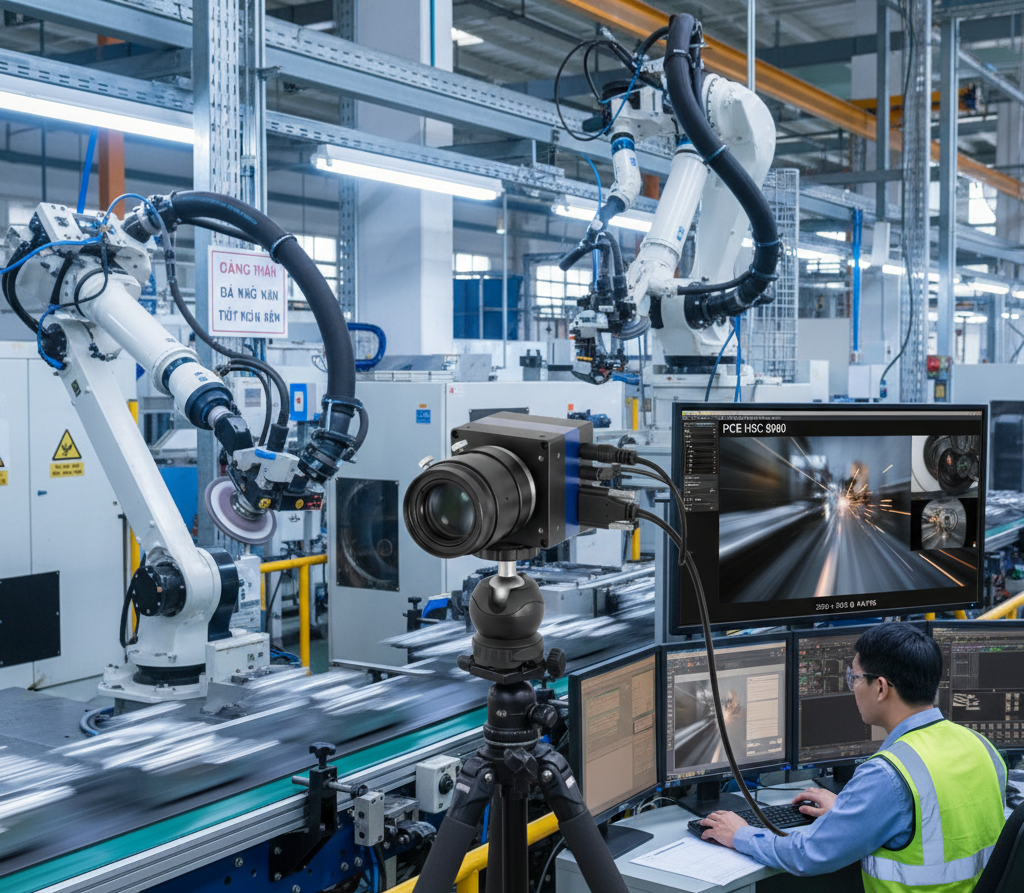
In practical use, cameras like the PCE HSC 1660 are generally suitable for basic motion observation or experiments where clear images and compact operation are required. For tasks demanding higher detail and speed, the PCE HSC 8960 offers an advantage thanks to its stable recording capabilities at high resolution, effectively meeting the needs of analyzing fast-moving subjects in industrial and research environments.
For more specialized applications such as impact testing, strain measurement, or dynamics research, the PHANTOM VE04K is chosen by many organizations due to its very high-speed recording capabilities, combined with accuracy and reliability in data acquisition.
How are high-speed cameras applied in practice?
High-speed cameras are becoming increasingly prevalent in many different fields.
In factories, these devices assist in monitoring the operation of machinery, detecting errors that occur in very short periods of time and are difficult for the naked eye to perceive. In research and training, cameras help analyze motion, evaluate physical phenomena, or simulate technical situations.
Several camera lines from PCE and Police are selected for applications requiring rapid observation, event recording, or training and monitoring in varying lighting and spatial conditions.
In the field of media and content creation, high-speed cameras offer a different perspective, helping to recreate movement in a more intuitive and vivid way.
Factors to consider when choosing a high-speed camera.
Before choosing a high-speed camera, users often focus on a few key factors instead of just the frame rate per second.
Recording speed determines the ability to capture fast-moving subjects. Resolution affects the level of detail in playback. Short exposure times result in sharper images and reduced blurring. Memory and data transfer capabilities are crucial when continuous recording or processing large amounts of data is required.
Additionally, the choice between color or monochrome cameras depends on the intended use. Monochrome cameras are often preferred for technical analysis or low-light conditions, while color cameras are more suitable for visual observation needs.
High-speed cameras at EMIN
EMIN currently offers high-speed camera solutions from established brands such as Ametek, Phantom, PCE, Logitech, and Police. The product portfolio is selected based on practical application, stability, and suitability for various scenarios.
Besides equipment, EMIN focuses on providing comprehensive solution consulting, assisting in the selection of cameras, accessories, and configurations tailored to specific needs. As a result, high-speed cameras go beyond simply recording; they become tools for analysis and optimizing work efficiency.