Standard value when testing insulation resistance
Most modern electrical devices, whether for household or industrial use, have both conductive parts and insulating layers for protection. Due to their varying construction characteristics, there is no fixed insulation resistance level for all devices; it depends on the voltage rating of each type.
For example, a motor rated at 690VAC will have a corresponding test voltage of 975.8VDC when calculated using the formula 690 x 1.414. Therefore, the appropriate measurement range should be 1kVDC.
For power cables from 0.6 to 1kV, if calculated according to the principle, the test voltage will be around 1.5kVDC. Therefore, before measuring, it is necessary to choose the correct test voltage level suitable for the device.
In practice, the voltage for insulation measurement is usually divided into two groups: high voltage and low voltage. High levels such as 1000V, 2500V or 5000V are used for large power equipment. Low voltages of about 500V are used for household or small voltage equipment.
For example, megomet devices, when testing a 22 transformer above 0.4kV, a 2500V megohmmeter is used to measure between the high winding and ground and between the high winding and the low winding. A 500V megohmmeter will be used to measure between the low winding and ground.
Each measurement will take two parameters at 15 seconds and 60 seconds, then calculate the dielectric absorption ratio by dividing the value of 60 seconds by 15 seconds. If the ratio is greater than 1.3, the device meets the requirements.
Which Megohmmeter should I choose for insulation testing?
Megohmmeter is a familiar device used to measure insulation between phases or between the core and the shell. The machine operates based on a closed pure resistance circuit with a high voltage source, from which the resistance is calculated by the formula U divided by I. Because the test voltage is large, special attention must be paid to safety when using it.
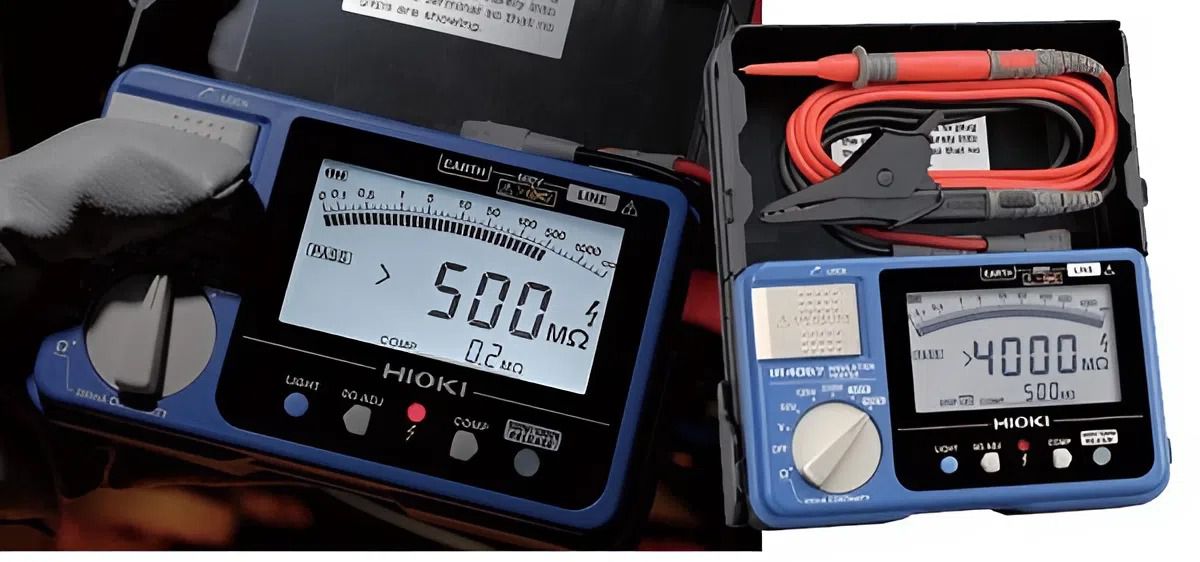
If you are looking for a measuring device, Hioki IR4056-21 is a very suitable choice.
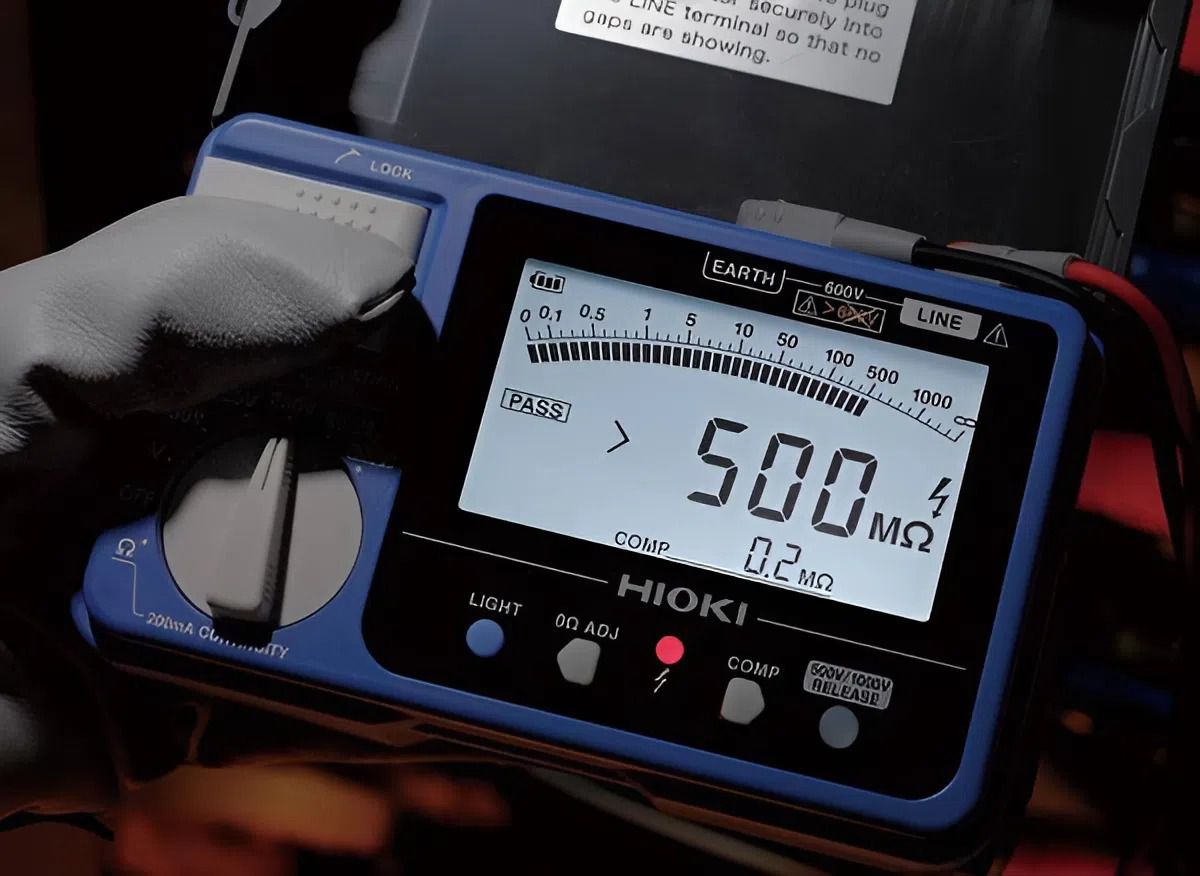
Hioki IR4056-21: Insulation Resistance Tester
The Hioki IR4056-21 is designed for high-precision insulation testing. It features five measurement ranges with a maximum test voltage of 1000V, an accuracy of only ±2 percent of the reading, and ±2 decimal places. Additionally, it supports testing EV and HEV systems and measuring conductor resistance at 200mA.
Features such as automatic Pass or Fail alerts, 600V AC overvoltage protection, and an integrated light ensure safer and more convenient operation.
Currently, IR4056-21 is commonly used in insulation testing of many types of electrical equipment, helping to detect leakage problems early so that timely measures can be taken to avoid affecting the entire system.