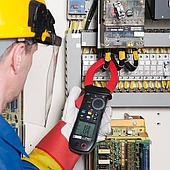
In using thermal cameras, understanding the limits of measuring distance and contact range is an important step to ensure accurate and reliable temperature measurement results. This EMIN article focuses on important factors such as resolution, instantaneous field of view (IFOV), and spot-size ratio, providing guidance on how to handle situations when measuring objects at different distances each other and provide useful advice to optimize the use of thermal technology. Mastering this information helps users access thermal cameras effectively and reliably, thereby applying it to many different fields with high efficiency.
1. Overview of Thermal Cameras
Thermal cameras, also known as infrared cameras, have become an indispensable tool in many fields, from military and medical to industrial and security protection. They work by sensing and recording images based on the emission of temperature rays, allowing us to "see" the world around us from a temperature perspective. However, to ensure the accuracy of temperature measurement results, we need to clearly understand the limits of the thermal camera's measuring distance and contact range.
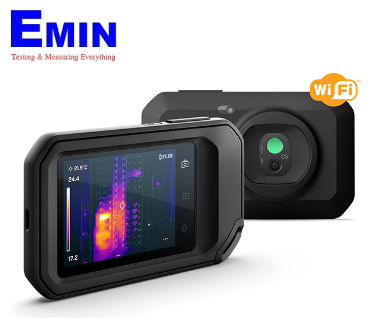
2. Resolution and Instant Field of View (IFOV)
To understand the measurement distance limits of thermal cameras, we need to master two important concepts: resolution and instantaneous field of view (IFOV).
Resolution: This is the number of pixels available on the thermal camera, and it determines the ability to divide the image into small parts. The higher the resolution, the more pixels you can represent an object, yielding greater detail in thermal images.
IFOV: Instantaneous field of view (IFOV) measures the angle at which each pixel on a thermal camera is visible. It is calculated in milli-radian terms and determines the camera's ability to scan and measure temperature at a specific distance.
3. Size - Point Ratio
Another important parameter is the point-size ratio, or theoretical point-size ratio. This is the value that indicates how far away you can test an object and still get accurate results.
For example, if the size-to-spot ratio is 19.62:15,000, this means that the thermal camera can accurately measure an object of at least 19.62mm from a distance of 15m. However, this single pixel measurement value can be inaccurate due to many factors such as pixel errors, reflections on objects, and distortions in the optical system.
4. Contact Range and Object Size
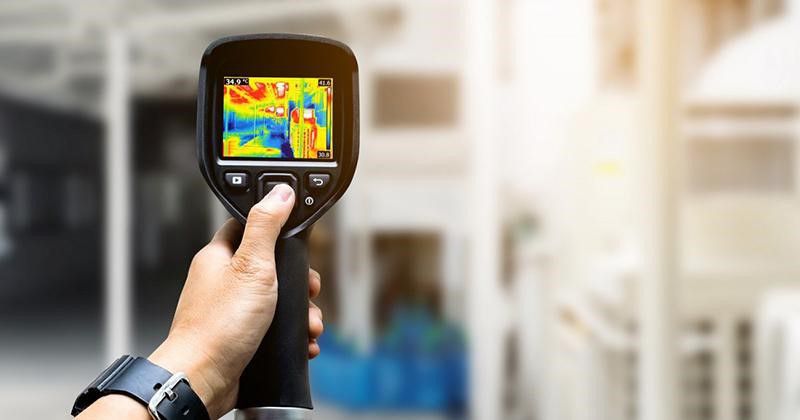
To ensure accuracy in temperature measurement, objects need to be represented on at least 3x3 pixels. This requires you to get closer to the object or use a higher resolution camera.
For example, if you want to accurately measure an object that is 20mm in size, and the camera has a resolution of 320x240 pixels, you can get accurate measurements from a distance of 5.1m.
5. Effects of Reflection and Temperature of Objects
When using thermal cameras, you need to be careful about reflections on objects. A small scratch or reflection from sunlight can cause temperature readings to be inaccurate. This is especially important when measuring bright and highly reflective surfaces.
Heating objects also play an important role in determining the accuracy of measurement results. For an object roughly the size of a pixel, the pixel's geometry is important. This requires that the heating area to be measured can be represented on a resolution of at least 3x3 pixels.
6. Optical Dispersion
Optical dispersion is an extremely important phenomenon that requires careful consideration. When radiation is from an extremely small area, it does not carry enough energy for the sensor to collect and convert into an accurate temperature value. For this reason, it becomes extremely important to ensure that the heating area you want to measure can be represented on a minimum resolution of 3x3 pixels. This will ensure that temperature measurement is performed with high accuracy and is not affected by optical dispersion.
EMIN'S THERMAL CAMERA PRODUCT LIST
Thermal camera for Smartphone UNI-T UTi120Mobile (120×90px, -20~400℃)
FLIR C3-X thermal camera (-20 ~ 300°C, 128 × 96, with wifi connection)
UNI-T UTi165A+ infrared thermal camera ( 160×120, -10°C~400°C, 6mrad)
UNI-T UTi32 thermal imaging camera (32×32; -20℃ ~ 1000℃; 0.15 ℃)
UNI-T UTi120T thermal camera (120×90pixels,-20~400°C)
FLIR E4 temperature camera (250 °C, 80 x 60 pixels, 10.3 mrad, realtime)
Camera nhiệt TESTO 865 (160x120pixels)
See more here!!!
Please contact us:
EMIN Viet Nam
Website: https://emin.vn
Hanoi: No. 203 Nguyen Ngoc Vu, Trung Hoa Ward, Cau Giay District, City. Hanoi. Tel: (024) 35.381.269; Email: hn@emin.vn
Bac Ninh: CL13-39 Him Lam Urban Area, Dai Phuc, Bac Ninh. Phone: (0222)730.39.68; Email: bn@emin.vn
Da Nang: No. 467 Dien Bien Phu, Hoa Khe Ward, Thanh Khe District, Da Nang City. Tel: (0236) 374 77 11; Email: dn@emin.vn
City. Ho Chi Minh: No. 110A Chu Van An, Ward 26, Binh Thanh District, Ho Chi Minh City. Tel: (028) 3811 96 36; Email: hcm@emin.vn
Facebook EMIN Viet Nam:
https://www.facebook.com/thietbido