Digital multimeters are widely used in electrical panels, manufacturing facilities, HVAC systems, electromechanical maintenance workshops, and professional field service applications. For beginners who are unfamiliar with how to measure electrical parameters using a multimeter, tasks such as measuring current, selecting the correct measurement range, testing electronic components, or interpreting measurement results often raise many questions.
20 article answers the most frequently questions for using multimeter
Covering handheld digital multimeter, pen-type multimeter, and bench digital multimeter, helping users understand their functions, avoid common measurement errors, and use their instruments more effectively. While most modern electrical testing is performed with digital multimeter, many of the measurement principles also apply to analog multimeter.
1. Why can't my digital multimeter measure current ?
When measuring current, the digital multimeter must be connected in series with the load so that the current flows through the meter's internal measurement circuit. If the test leads are connected in parallel, as they are for voltage measurements, the meter cannot measure the current correctly and may blow its internal protection fuse. Always verify that the test leads are inserted into the correct input terminals before performing a current measurement.
2. Why did the multimeter fuse blow ?
A blown fuse is typically caused by measuring a current that exceeds the meter's rated limit, leaving the test lead in the current input jack while attempting to measure voltage, or accidentally creating a short circuit while the meter is set to the current (Ampere) measurement mode. The fuse protects the internal measurement circuitry, so it should always be replaced with the exact type and rating specified by the manufacturer.
3. Can selecting the wrong measurement range damage the multimeter ?
Some digital multimeters include overload protection that can tolerate an incorrect function selection, but this protection is not guaranteed in every situation. Measuring resistance, diode forward voltage, or continuity on an energized circuit may damage the meter's internal circuitry. Always identify the electrical quantity to be measured and select the appropriate measurement function before testing.
4. Should capacitors be discharged before measuring them with a multimeter ?
Yes. Capacitors can retain a residual charge even after power has been removed. Measuring a charged capacitor may produce inaccurate readings and potentially damage the meter's internal circuitry. When testing capacitors in switch-mode power supplies (SMPS), variable frequency drives (VFDs), or other high-power equipment, discharge the capacitor safely before taking measurements.
5. Why is the multimeter display fluctuating ?
A continuously changing display may result from an unstable input signal, poor probe contact, low battery voltage, or electromagnetic interference (EMI). In industrial environments, fluctuating readings may also reflect the characteristics of the power source or the operating load rather than a fault in the instrument.
6. When should the HOLD function be used ?
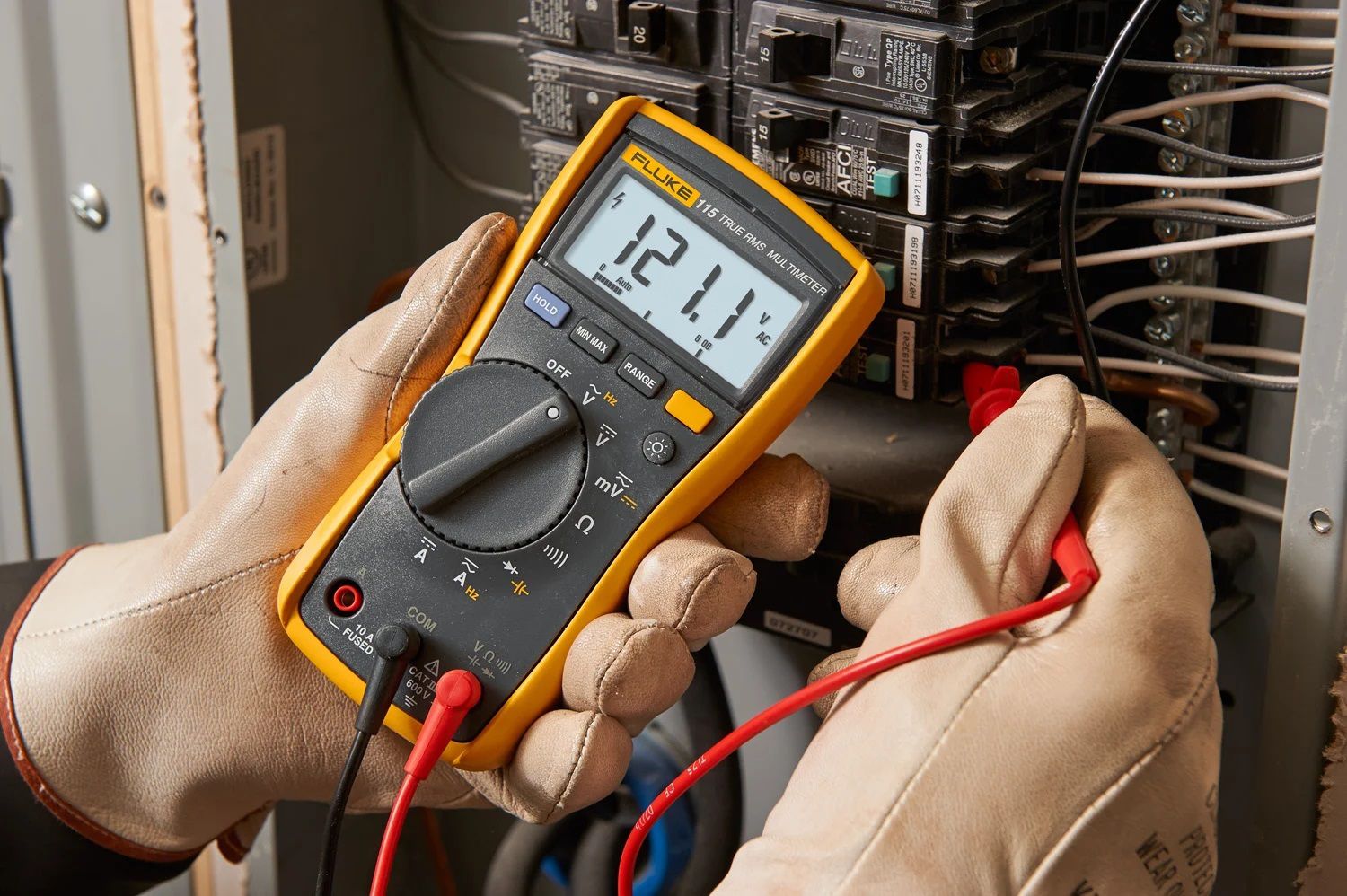
The HOLD function freezes the measured value on the display after a reading has been taken. It is especially useful when working inside electrical panels, in hard-to-see locations, or whenever the measurement must be recorded without continuously viewing the display.
7. What is the REL function on a digital multimeter ?
REL (Relative Mode) stores a reference value and displays only the difference between subsequent measurements and that reference. This feature is commonly used for low-resistance measurements to compensate for test lead resistance or to compare measurement variations between different test points.
8. What is the purpose of the MIN/MAX function ?
The MIN/MAX function records the minimum and maximum values measured over a period of time. It is particularly useful for monitoring fluctuating power supplies, capturing motor startup voltage variations, or detecting brief electrical anomalies.
9. When should the Peak Capture function be used ?
Peak Capture records transient peak values that occur over very short durations. It is useful for measuring inrush current, voltage spikes, and other fast transient events that standard measurement modes may fail to capture.
10. How do you test a diode with a digital multimeter ?
In Diode Test mode, the multimeter applies a small test current through the diode and measures its forward voltage drop. A properly functioning diode conducts in the forward direction and blocks current in the reverse direction. This provides a quick and effective method for troubleshooting electronic circuits.
11. Can a digital multimeter test a transistor?
Yes. Some multimeter models include a dedicated socket for testing BJT (Bipolar Junction Transistor) devices. For models without this feature, technicians can perform a basic transistor check using the diode test function to identify short circuits or damaged PN junctions.
12. Can a digital multimeter test a MOSFET ?
Yes, but only at a basic level. A multimeter can detect common faults such as a short circuit between the Drain and Source terminals or leakage at the Gate. However, it cannot evaluate switching performance or dynamic characteristics, which require specialized semiconductor testing equipment.
13. Can a digital multimeter measure PWM signals ?
Yes, although the accuracy depends on the instrument's signal-processing capability. For high-frequency PWM signals, most multimeters display only the average or True RMS value. An oscilloscope is recommended whenever waveform analysis or duty-cycle measurement is required.
14. Can a digital multimeter measure the output of a variable frequency drive (VFD) ?
Yes, provided the appropriate instrument is used. Since VFD outputs are PWM waveforms, a True RMS digital multimeter provides significantly more accurate readings than an average-responding meter.
15. Can a digital multimeter test a solar inverter ?
Yes. A digital multimeter can verify both the DC input voltage from the photovoltaic array and the AC output voltage of the inverter. When working on photovoltaic systems, always use a meter with an appropriate CAT safety rating to minimize risks associated with high-voltage measurements.
16. Can a digital multimeter test lithium batteries ?
A multimeter can measure battery voltage and identify voltage differences between individual cells. However, voltage alone does not accurately indicate battery capacity or state of health (SOH). Comprehensive battery evaluation requires additional instruments capable of measuring internal resistance and discharge performance.
17. Can a digital multimeter measure pulse voltage ?
The ability to measure pulse voltages is limited by the meter's sampling rate. For rapidly changing signals, the displayed value may not accurately represent the actual waveform. Oscilloscopes are the preferred instruments for pulse and transient signal analysis.
18. Can a digital multimeter test sensors ?
Yes. A digital multimeter can verify supply voltage, output voltage, or resistance for many types of sensors. In industrial applications, these measurements provide a fast method for identifying power supply issues or signal transmission faults before more advanced diagnostics are performed.
19. Can a digital multimeter be used to troubleshoot a PLC ?
A multimeter cannot analyze or diagnose a PLC program. However, it can measure related electrical signals such as the 24 VDC power supply, digital inputs, digital outputs, and analog signals. Troubleshooting PLC logic and communication faults requires dedicated programming and diagnostic software.
20. Can a digital multimeter measure a 4–20 mA current loop ?
Yes. Measuring a 4–20 mA current loop is a common task in industrial automation. During this measurement, the multimeter must be connected in series with the current loop and configured for DC current measurement to avoid interrupting the control signal.