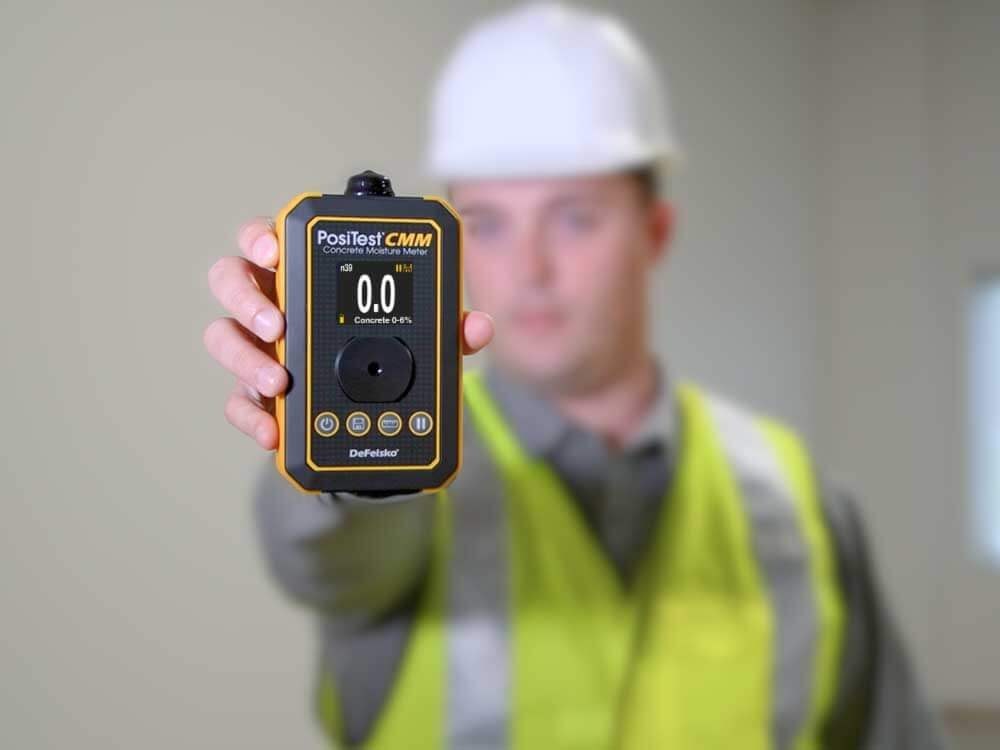
A concrete moisture meter can quickly identify comparatively wetter areas of a concrete slab without drilling. Non-destructive electronic impedance meters, including the PosiTest CMM, measure moisture conditions near the surface and are useful for screening and comparing locations.
Because concrete composition and nearby reinforcing steel can affect impedance readings, a meter reading should be interpreted as a comparative indication rather than a complete picture of moisture throughout the slab. In-situ relative humidity probes can complement non-destructive testing when evaluating slab moisture condition.
What is a non-destructive concrete moisture meter?
A non-destructive concrete moisture meter is an electronic impedance meter that evaluates moisture near the concrete surface without drilling into the slab. It is particularly suited to locating areas with relatively higher moisture for further assessment.
The method measures the top ¾ inch of the slab surface. This makes it different from an in-situ relative humidity probe, which uses a drilled test hole to evaluate conditions within the concrete.
How does an electronic impedance meter measure concrete moisture?
An electronic impedance meter sends an alternating electric field through the concrete from its transmitting sensor pins and captures it with receiving electrodes. The instrument measures electrical impedance, which changes in relation to moisture in the concrete.
With calibration against concrete standards of known moisture levels, the meter can display measurements in concrete moisture units. Higher moisture content is associated with a higher impedance reading in the described measurement principle.
What can affect a concrete moisture meter reading?
Concrete composition, reinforcing steel close to the surface, chlorides, carbonates, and similar materials may affect impedance-based readings. A reading should therefore be considered in the context of the slab and the materials present.
Surface condition also matters. Dirt, dust, liquids, coatings, flooring, adhesives, and other contaminants should be removed from selected test areas, and the sensor pins must contact the concrete directly.
How is the PosiTest CMM used for a slab moisture check?
The PosiTest CMM is placed on the prepared concrete surface and pressed down until its sensor pins are fully compressed. It is designed to measure on smooth, rough, or uneven concrete surfaces, provided the pins make direct contact.
Before measuring, select one of its three scales: Concrete 0–6%, Carbide Measurement Equivalent 0–4%, or Relative 0–100%. The available measurement modes are Continuous Measurement, Hold Max, and Hold Max and Save.
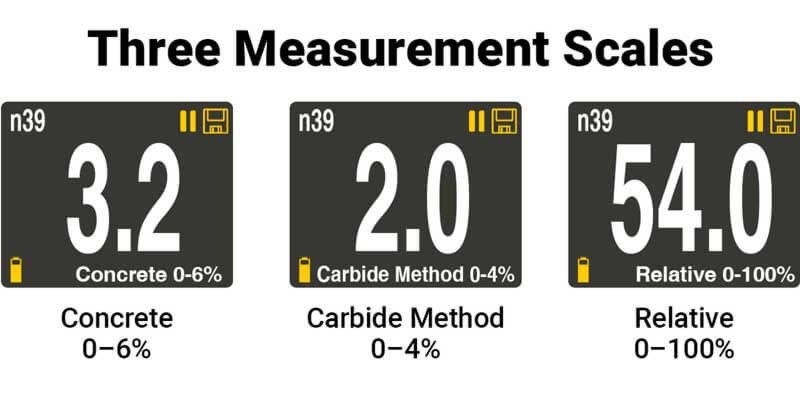
Continuous Measurement updates the displayed value while the meter is on the surface. Hold Max retains the highest reading until it is saved or discarded, while Hold Max and Save waits for stabilization, stores the reading automatically, and resets the display.
How should operation be checked before concrete moisture testing?
Operation can be checked with the supplied Check Standard before taking measurements. Place the Check Standard on a flat, non-conductive surface, press the meter down until the pins are compressed, and compare the displayed value with the range shown on the standard.
If the displayed reading falls within that stated range, the instrument is operating correctly according to this check. Keeping both the meter pins and the test surface clean supports consistent contact during testing.
What does ASTM F2659 involve for comparative moisture testing?
ASTM F2659 provides guidance for preliminary, comparative moisture-condition evaluation of concrete, gypsum cement, and other floor slabs or screeds using a non-destructive electronic moisture meter. The standard should be reviewed directly for full requirements and compliance.
The supplied procedure states that the slab should be at service temperature for at least 48 hours before testing. The air above the slab should also be at service temperature and at the relative humidity expected during normal use; where this is not possible, the stated alternative conditions are 75°F ±10°F (24°C ±5°C) and 50% ±10% relative humidity.
How many readings are taken at each ASTM F2659 test location?
For the described ASTM F2659 procedure, take three to five meter readings within a 1 ft² (929 cm²) area at each test location and report the maximum value. The procedure also calls for recording relative humidity, air temperature, dew point, and concrete surface temperature near each location.
The source procedure identifies at least eight test locations for the first 1,000 ft² (100 m²), plus at least five additional locations for every additional 1,000 ft² (100 m²). Test locations should be distributed across the slab, including central areas and areas near exterior walls, while avoiding direct sun or other heat sources when assessing suspected high-moisture areas.
What information should a comparative concrete moisture report include?
A comparative moisture report should identify the test locations and the highest moisture reading at each location. It should also include the relative humidity, ambient air temperature, and dew point temperature above each test area.
Additional observations, location details, and inspector information may also be recorded. Stored readings from the PosiTest CMM can be downloaded through its built-in USB port for viewing and reporting with PosiSoft Desktop.