Package drop testing helps quality teams evaluate how a carton or packaged product responds to handling impacts that may occur during transport. Packages can be exposed to shock, vibration, compression, and accidental drops before they reach their destination. A controlled drop test gives manufacturers a repeatable way to observe potential damage, identify weak areas in a packaging design, and compare packaging changes under defined conditions.
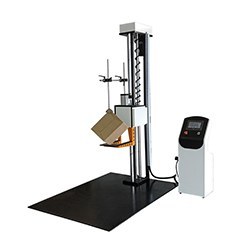
The GT-LC05-1 Single Wing Falling Tester is designed to assess package damage and impact resistance during transport. It is intended for free-fall tests of package surfaces, edges, and angles. For businesses working in quality control and inspection, this type of equipment can support a more structured approach to evaluating whether a package design is appropriate for its expected handling conditions.
Why package drop testing matters
Packaging has two connected functions: containing the product and helping protect it during distribution. If the package does not perform as intended, product damage, rework, replacement activity, and customer dissatisfaction may follow. Drop testing does not eliminate every transport risk, but it can reveal visible damage or design concerns before packaging is used more broadly.
A test program can be useful when introducing a new carton, changing internal protection, comparing materials, or reviewing a package after transport-related damage. The result should be considered alongside the product type, package configuration, handling process, and the acceptance criteria established by the organization conducting the test.
GT-LC05-1 testing approach
The carton drop tesster is described as a single wing falling tester for package testing. Its free-fall capability allows evaluation of three common impact orientations: the package surface, an edge, and an angle. Testing across these orientations is valuable because each contact point can place stress on the carton and its contents differently.
The source information describes a single-arm, double-column structure with electric reset, electric drop, and electric lifting functions. The single-arm arrangement is intended to make placement of the test item easier. It also states that the tester can perform an angle drop where the angle between the impact surface and the bottom-plate plane is less than or equal to 5°.
Drop-height control
Consistent height control is central to meaningful package drop testing. According to the available product information, the GT-LC05-1 uses a digital display height meter and a decoder for height tracking. The stated default drop-height error is no more than 2% or 10 mm. Recording the selected height and impact orientation for every test helps teams compare test runs and investigate differences in package performance.
Buffering and operational design
The product description also identifies a hydraulic buffer device intended to support machine life, stability, and safety. Combined with electrically operated lifting, resetting, and dropping functions, these features are positioned to make repeated test cycles more manageable for operators. Actual maintenance practices, operating procedures, and safety controls should follow the equipment documentation and the test facility's requirements.
Building a useful carton drop test process
Effective testing begins with a clear objective. Teams should define what they need to learn, such as whether a carton protects a product during a selected drop sequence or whether a revised insert improves performance. They can then prepare representative samples and establish the intended test orientation, drop height, number of drops, and inspection criteria.
After each drop, inspect both the package and the product. Useful observations may include torn board, crushed corners, opening of seals, movement of internal components, cosmetic damage, or loss of product function. Documenting these observations consistently makes it easier to compare alternative designs and decide whether further development is needed.
The source lists ISO2248, JISZ0202-87, GB/T4857.5-92, and ISTA in connection with package drop testing. Organizations should confirm the applicable version, test conditions, and acceptance requirements for their own product and market before using any standard as a test basis.
Using test results to improve packaging
Package drop testing is most valuable when results inform a design decision. A failure may indicate that the carton, cushioning, internal layout, closure, or product restraint requires review. Conversely, acceptable results can provide evidence for an internal packaging evaluation when the test conditions and observations are properly recorded.
The Single Wing Falling Tester provides a controlled method for examining packaging impact resistance through surface, edge, and angle drops. By combining repeatable equipment settings with a documented inspection process, manufacturers can use package drop testing to better understand packaging behavior during transport-related handling.