In laboratory work, research, and radiation monitoring, using a radiation detector and understanding radiation units correctly are essential for interpreting measurement data, distinguishing different quantities, and communicating results consistently. Units such as Bq, Gy, and mSv describe different physical quantities: some indicate radioactive activity, some describe the energy absorbed by matter, and others are used for radiation protection.
Radioactive Activity and the Becquerel (Bq)
Activity is the quantity used to describe the rate of radioactive decay of a source. It represents the number of nuclear transformations occurring per unit of time. The SI unit of activity is the becquerel (Bq).
An activity of 1 Bq corresponds to one nuclear transformation per second. The non-SI unit curie (Ci) is also commonly referenced, with:
1 Ci = 3.7 × 10¹⁰ Bq
Activity describes the rate of nuclear transformations in a radioactive source. However, it does not by itself indicate the radiation dose that a material or person may receive.
Surface Emission or Flux Density from Contaminated Surfaces
When assessing radiation emitted from a contaminated surface, particle flux density may be used. It describes the number of particles passing normally through a unit area per unit time. The unit can be expressed as particles/(s·m²).
This quantity differs from both radioactive activity and absorbed dose. Therefore, when interpreting instrument readings or measurement records, it is important to identify exactly which quantity is being reported rather than comparing numerical values directly.
In practice, a radiation meter does not necessarily display activity directly in Bq. Depending on the detector principle and measurement configuration, the instrument may provide count rate (CPM/CPS), dose rate, or other radiation-field parameters.
Determining the activity of a source in Bq requires an appropriate measurement method, calibration, and measurement geometry. A CPM or dose-rate reading cannot be directly converted into Bq without the necessary conversion factors and measurement conditions.
Absorbed Dose and Absorbed Dose Rate
Absorbed dose describes the energy deposited by ionizing radiation in matter. Its SI unit is the gray (Gy).
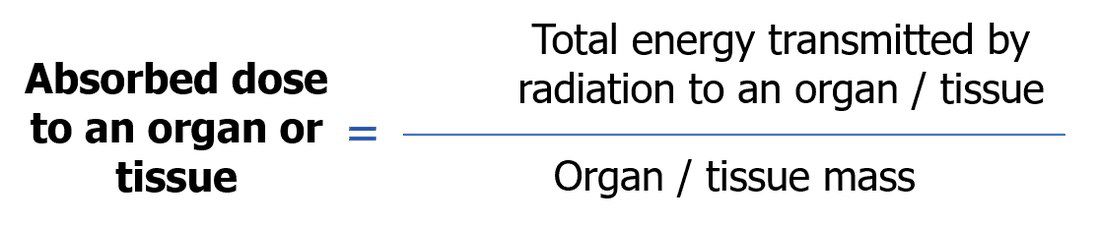
One gray corresponds to 1 joule of radiation energy absorbed per kilogram of matter.
The absorbed dose rate describes the rate at which absorbed dose is accumulated over time. For example, 1 Gy/s means that 1 kg of material absorbs 1 joule of radiation energy per second.
Absorbed dose is useful for describing the physical interaction between radiation and matter. However, it does not by itself account for differences in biological effects between radiation types or differences in the sensitivity of individual tissues.
In practical measurements, a radiation meter does not necessarily display activity in Bq. Depending on the detector and measurement configuration, it may provide count rate (CPM/CPS), dose rate, or other radiation-field parameters. Determining source activity in Bq requires an appropriate measurement method, calibration, and measurement geometry.
Equivalent Dose: Accounting for Radiation Type
Different types of radiation can produce different biological effects for the same absorbed dose. To account for this difference, equivalent dose uses a radiation weighting factor, wR.
For an organ or tissue T:
Hₜ = wR × Dₜ
where Dₜ is the mean absorbed dose in the organ or tissue, and wR is the radiation weighting factor for the radiation type.

This approach provides a more meaningful basis for radiation protection than considering absorbed energy alone.
It is important to note that a value displayed by a portable radiation meter, such as an ambient dose equivalent rate in µSv/h, is not the same as the equivalent dose Hₜ received by a specific organ. These are different quantities with different definitions, measurement conditions, and purposes.
Field instruments primarily provide information about the radiation field at the measurement location. Assessment of personal or organ-specific dose requires the appropriate dosimetric quantities and measurement methods.
Effective Dose and Tissue Sensitivity
Different organs and tissues do not have the same sensitivity to radiation. Effective dose accounts for this difference by applying tissue weighting factors, wT.
The effective dose is calculated as:
E = ΣT(wT × Hₜ)
The radiation and tissue weighting factors defined in ICRP Publication 103 are intended for radiation protection purposes and incorporate conservative assumptions.
For occupational radiation monitoring, operational quantities such as ambient dose equivalent are also used to support radiation measurements and dosimetry.
Therefore, a dose-rate value measured by a radiation meter should not be equated directly with a worker's effective dose. Dose rate describes the rate at which dose is accumulated at a specific measurement location, while effective dose is a radiation-protection quantity derived from equivalent doses to different tissues and their respective weighting factors.
In occupational exposure assessment, factors such as exposure conditions, working time, body position, and personal dosimetry data should be considered together.
Radiation Dose Limits
According to ICRP Publication 103 (2007), the reference data specify annual dose limits for occupational and public exposure from planned sources, in addition to natural background radiation.
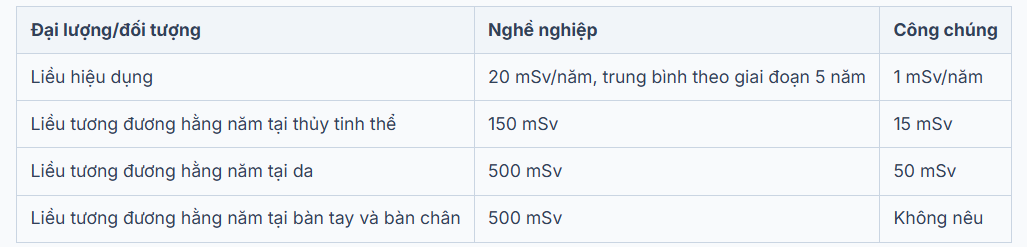
For occupational exposure, the effective dose limit is 20 mSv per year averaged over defined 5-year periods, with no more than 50 mSv in any single year.
For members of the public, the effective dose limit is 1 mSv in a year, subject to specific circumstances permitted by the relevant radiation protection framework.
These effective dose limits include the relevant contribution from external exposure during the specified period and the committed effective dose resulting from the intake of radioactive substances. The reference period for committed dose is 50 years for adults and up to age 70 for children.
Components of natural background radiation exposure and the average annual dose
Interpreting Radiation Exposure Levels
High absorbed-dose values can be used to describe the potential for acute radiation injury. Depending on the dose and exposure conditions, absorbed doses in the range of approximately 1–10 Gy can be associated with acute radiation syndrome. At higher doses, severe gastrointestinal and systemic effects may become increasingly significant.
However, these values are absorbed doses in Gy and are not parameters that can be directly read from every radiation meter.
During field surveys, instruments commonly display dose rate, such as µSv/h or mSv/h, or count rate, such as CPS/CPM, depending on the detector. These quantities characterize the radiation field or detected radiation at the measurement location and should not be treated as equivalent to the absorbed dose received by a specific organ or the whole body.
Therefore, when using a radiation meter to assess a radiation field, it is important to distinguish between an instantaneous measurement and an individual's accumulated dose. The measured dose rate represents the exposure rate under specific measurement conditions. Estimating the dose received also requires consideration of exposure time, source-to-person distance, irradiation geometry, radiation energy, and radiation type.
For low-level radiation fields or measurements with significant statistical variation, measurement time also affects result stability. Radiation meters based on pulse-counting detectors require an appropriate integration time to reduce statistical uncertainty. Detector energy response and calibration should also be considered before using measurement results for radiation safety assessment.
Actual exposure does not depend solely on the dose rate at a single point in time. A person working for a long period in a relatively low radiation field may still accumulate a significant dose. Conversely, a high dose-rate reading recorded for only a very short period cannot be interpreted simply as the person's whole-body dose.
Therefore, radiation exposure assessment should combine data from a radiation meter, exposure time, irradiation conditions, and personal dosimetry data when evaluating occupational exposure. An instantaneous measurement should not be used on its own to determine biological effects or directly compare exposure with an annual dose limit.