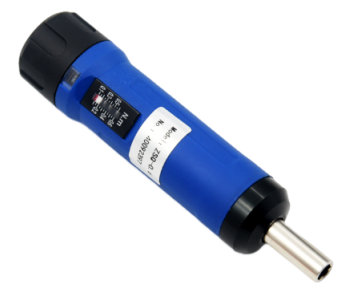
Click drivers are fastening tools that begin operating when the user applies deliberate pressure against the workpiece. In assembly settings, this start method can provide a more natural working motion than a trigger-start tool while supporting controlled, repeatable fastening.
They are suited to manufacturing, assembly, and maintenance tasks where operators perform repeated fastening cycles and need to follow defined torque requirements. The practical value depends on the application, the required torque specification, and the operator's workflow.
What is a push-to-start driver?
A push-to-start driver is a tool activated by pressing it into the fastener or workpiece rather than pulling a trigger. The deliberate axial pressure initiates the tool, combining positioning and starting motion in one action.
This operating method is relevant where a worker repeatedly places a driver on fasteners during an assembly sequence. Because the tool requires intentional contact pressure to start, it differs from a trigger-start approach in how the operator initiates each cycle.
Why can push-to-start drivers improve operator comfort?
Push-to-start drivers can improve comfort by using a simple pressing motion that may reduce the need for repeated squeezing or pulling. This motion is intended to place less strain on the hand and wrist during extended use.
For operations involving daily, repeated tool use, reducing unnecessary hand movement can help make the task easier to sustain. Ergonomic suitability should still be assessed in the context of the workstation, the fastening position, and the duration of the work.
How do push-to-start drivers support torque consistency?
Push-to-start drivers are intended to apply torque directly and uniformly to the workpiece, helping support repeatable fastening results. This is particularly important when an assembly process calls for specific torque requirements.
Consistent torque application can help avoid issues associated with an incorrect fastening result, such as potential component damage or improper assembly. In precision work, a repeatable process also helps maintain the quality expectations established for the task.
How can a push-to-start mechanism reduce accidental starts?
A push-to-start mechanism requires deliberate pressure before the driver starts, which can reduce the likelihood of unintended activation compared with trigger-start tools. Avoiding accidental starts can help limit safety risks as well as unnecessary material waste or damage.
This does not replace normal workplace safety practices. Operators should use the tool according to the requirements of the specific application and ensure the workpiece and fastening position are properly controlled before beginning a cycle.
When are faster fastening cycles useful?
Faster cycles are most useful in high-volume production environments where many similar fastening operations are performed. A quick push-to-start action can reduce time spent initiating each fastening cycle and support a more efficient workflow.
The resulting productivity benefit depends on the wider process, including part handling, positioning, torque requirements, and inspection steps. The start mechanism is one part of the cycle, so it should be considered alongside the complete assembly operation.
Which Mountz tool series include push-to-start options?
Mountz identifies ECT 4000 and 5000 as push-to-start models for a range of tasks. For simpler applications, push-to-start options are also available among basic screwdriver offerings in the NF, BF, LF, and K series.
Tool selection should match the application rather than relying on the start method alone. Review the fastening task, required torque specification, production volume, and operator workflow to determine whether a push-to-start option is appropriate.
How should an assembly team evaluate a push-to-start driver?
What Should You Evaluate Before Choosing a Push-to-Start Torque Screwdriver?
Push-to-start torque screwdrivers are widely used in repetitive assembly, manufacturing, and maintenance operations. A push-to-start torque screwdriver is suitable when the process requires direct push activation, controlled tightening torque, and a reduced risk of unintentional tool activation.
- Determine the required tightening torque and accuracy for the application.
- Evaluate the operator’s working posture, operating duration, and frequency of use.
- Consider the risk of unintentional activation in the work area.
- Compare cycle times across the entire assembly process.
- Check the available torque screwdriver and select a configuration that matches the actual application.
An assembly team should evaluate whether deliberate push activation fits the work position, repeatability requirements, and expected cycle volume. The strongest use case is a repeated fastening process where ergonomic motion, controlled starts, and efficient cycles are all relevant.
A practical evaluation can compare the tool's operating motion with the current trigger-start process, then confirm that the selected driver meets the torque needs of the assembly. This keeps the decision focused on the actual process requirements rather than a single feature.