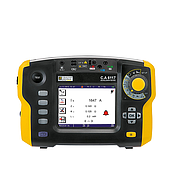
What does electronic total station mean?
The name sounds confusing but it's actually very simple. An electronic total station is a multi-purpose electronic optical device, used for surveying and construction work. In terms of structure, the machine is a combination of an electronic theodolite and an electronic distance measuring unit (EDM), helping to accurately read the distance between two high points (the machine's standing point and the point to be measured).
Operating principle of electronic total station?
Electronic total stations operate on the principle of receiving and transmitting signals. The device location will contain the transceiver, while the reflector is placed at the location to be measured. The signal transmitter sends a signal to the mirror, which reflects the signal back to the receiver of the device.
The distance to be measured is calculated according to the formula: D = vt/2, in which:
- D is the distance to be measured
- v is the signal transmission speed (v = 3 x 10^8 m/s)
- t is the time the signal travels and returns.
The measurement programs of electronic total stations help perform the following tasks:
- Point layout (S-O) and curved destination (S-O Arc)
- Measure Offset: edge (Distance), angle (Angle), two edges - hidden points (2D), plane (Plane), column (Column)
- Measure angles (Angle), edges (Distance), coordinates (Coordinate)
- Topographic survey measurement (Topography, Topo)
- Indirect edge measurement (Missing Line – MLM)
- Measuring height beyond reach (REM)
- Measure the deviation of the pass (Traverse)
- Determine the intersection point between two lines (Intersection)
- Horizontal measurement (Xsection)
- Calculate flat and inclined area (Area)
- Straight line destination layout (S-O Line)
- Determine the point to any reference line (Point To Line)
- Projecting points onto the reference line (Point Project)
- Road measurement: straight line (Line), curve (Circular Curve), spiral line (Spiral), parabola (Parabola), three-point curve (3PT Curve), tangent and intersection line (IP&Tan), Alignment calculation
Applicability of the machine:
Understanding the measurement programs of electronic total stations helps us apply this device in many fields:
- In industrial and civil construction: Positioning pile centers, pressing piles, locating shaft centers to build walls, transferring design points to the field.
- Measurement in the fields of transportation and irrigation.
- Cadastral survey, topography, and map creation.
Note when using the device
Because it is an electronic device, to increase the lifespan of an electronic total station, you should note the following:
- Store the machine in a dry, clean place, away from moisture and dust.
- Place the machine in an anti-collision box when moving.
- Regularly clean and sanitize the machine to remove dirt.
- Charge the battery fully before use, avoid letting the battery run out frequently.
- Use genuine batteries to avoid battery wear or damage.
- Periodic maintenance for the machine.
Above are my shares about electronic total stations, their concepts, features and uses. You can refer to the product at Genuine Total Stations that EMIN provides here!