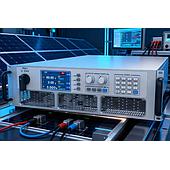
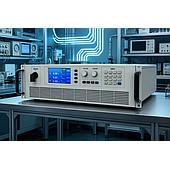
A programmable AC test power supply supplies controlled AC input conditions so a switching power supply can be evaluated beyond one fixed rated voltage. It can support tests of input characteristics, input-voltage regulation, abnormal input behavior, dynamic response, and automated end-of-line procedures.
This matters because chargers, adapters, and PC power supplies may operate on grids with voltage variation, dips, interruptions, or interference. A controlled AC source lets a production line reproduce selected conditions and record how the unit under test responds.
Summary: A programmable AC source can vary voltage and frequency and simulate sags or interruptions. It supports input, regulation, abnormal-input, and dynamic-response tests. In automated test equipment, preset conditions and measured results can be recorded for pass/fail decisions and traceability.
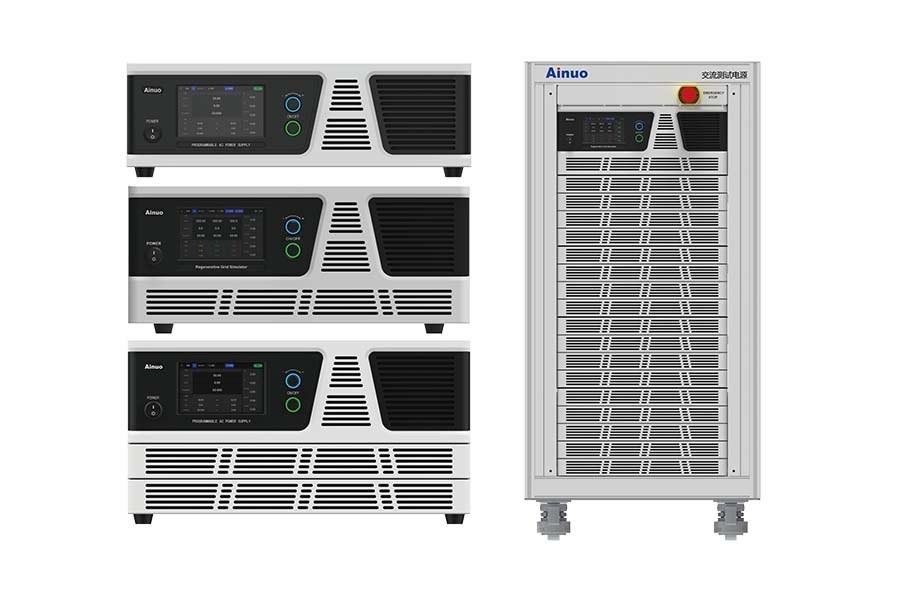
What does a programmable AC test power supply do on a switching power supply line?
It acts as a controllable AC input source for verifying a switching power supply under normal and selected abnormal grid conditions. Rather than setting one voltage manually, test software can apply a defined sequence of voltage conditions and coordinate measurements with the rest of a test system.
The intended checks include whether a unit operates without damage at selected input limits, whether its output remains within the required range as input changes, and whether protective behavior is correct during an interruption or voltage dip.
Which input characteristics can be checked with a programmable AC source?
At a rated input voltage, the source can provide stable, measured AC for checking specified input current, power, power factor, efficiency, and related input parameters. The production-line objective is to determine whether the unit's measured consumption and efficiency align with the applicable requirements.
The source is part of the input-side setup; additional measurement equipment may be used to capture the relevant electrical values. For example, the source material identifies 220 Vac as one possible rated-voltage test point.
How is input-voltage regulation tested?
Input-voltage, or line, regulation is assessed by changing the AC input and measuring the switching power supply output. A programmable source can step or sweep the input automatically while the output voltage is observed.
One example sequence changes the input from 90 Vac to 264 Vac. The acceptable output-voltage variation is product-specific; the source material gives ±1% only as an example, not as a universal requirement.
What abnormal input conditions can a programmable AC test power supply simulate?
A programmable AC test power supply can apply high and low input limits, gradual voltage ramps, voltage sags, and complete interruptions. These conditions are used to examine robustness and recovery behavior under non-ideal input power.
| Test condition | What the test can examine | Example from the source data |
|---|---|---|
| Voltage limit | Whether the unit continues to operate normally without damage at selected low and high inputs | 85 Vac and 275 Vac |
| Voltage ramp-up or ramp-down | Adaptability to gradual grid-voltage changes | Slow input-voltage fluctuation |
| Voltage sag | Restart, freeze, output recovery, and protection behavior after a temporary input drop | 220 Vac to 100 Vac for 100 ms |
| Interruption | Response to loss of the AC input and subsequent recovery | 0 Vac |
For sag and interruption tests, practical questions include whether the product restarts or freezes, whether the output returns to normal after restart, and whether an internal function such as undervoltage lockout (UVLO) operates as intended.
Can it be used for pre-compliance immunity testing?
Yes, it can be used on the production line to reproduce voltage dips, short interruptions, and voltage-variation waveforms for pre-compliance evaluation. The source data notes IEC 61000-4-11 and IEC 61000-4-13 as examples of standards associated with power-supply immunity testing.
Note: A production-line pre-test is not the same as official certification. Its role is to check defined conditions before formal evaluation and identify issues that may require correction.
How does a programmable AC source help evaluate dynamic response?
It can create a rapid input-voltage step so the switching power supply's control-loop response can be observed. The evaluation can focus on output-voltage overshoot, oscillation, and the time required to return to a stable output state.
The source material gives a step from 180 Vac to 240 Vac as an example. The appropriate step profile and acceptance limits depend on the product being tested.
How is a programmable AC test power supply used in automated end-of-line testing?
In automated test equipment (ATE), software can command the AC source to apply preset voltage conditions in sequence while other instruments measure the unit under test. A robotic arm may connect the power supply to a fixture, while a programmable DC electronic load applies the output load.
An example sequence includes 90 V, 110 V, 220 V, 264 V, and an interruption. A data-acquisition card can measure output voltage, ripple, and other parameters; the system then compares recorded results with predefined limits to assign a PASS or FAIL result.
Where connected to a manufacturing execution system (MES), those recorded results can support quality traceability. The exact fixture, instruments, limits, and software workflow should be defined for the specific production process.
How does it differ from a traditional Variac?
A traditional Variac is primarily used for manual voltage adjustment, while a programmable AC test power supply is intended for digitally controlled test sequences and automation. The source data also describes programmable units as supporting frequency adjustment and simulations such as sags, interruptions, and harmonics.
| Capability | Traditional voltage regulator (Variac) | Programmable AC test power supply |
|---|---|---|
| Adjustment method | Manual adjustment and reading | Digital, automatic measurement and control |
| Test speed | Manual and slower for repeated sequences | Fast switching for automated sequences |
| Test functions | Primarily voltage adjustment | Voltage and frequency adjustment; sag, interruption, and harmonic simulation |
| System integration | Not described as automated | Interfaces such as LAN and GPIB are identified for ATE integration |
When should a production line consider this type of AC test source?
It is relevant when a line needs repeatable testing at multiple input conditions, needs to examine behavior during dips or interruptions, or needs to automate pass/fail evaluation. It is also useful when test records must be retained as part of a traceability workflow.
Selection should begin with the required voltage conditions, waveform and disturbance tests, measurement arrangement, automation interfaces, and the product-specific acceptance limits. These requirements determine whether the source fits the intended switching power supply test process.